
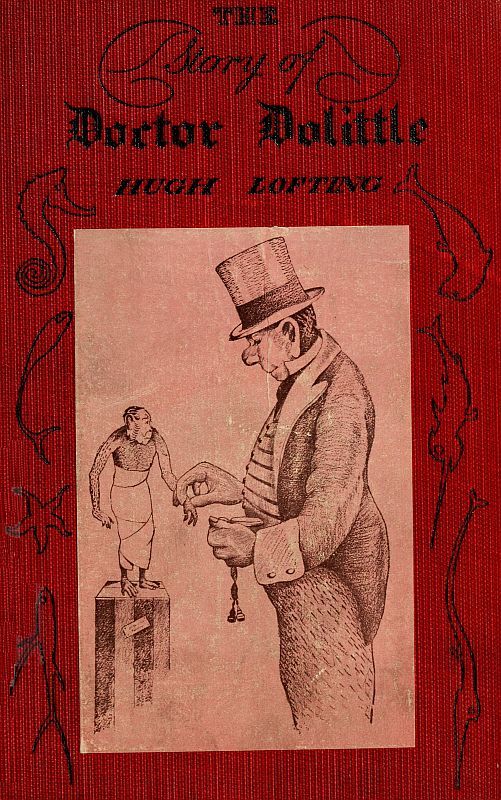
THE STORY OF DOCTOR DOLITTLE
[i]
THE STORY OF DOCTOR DOLITTLE[ii]
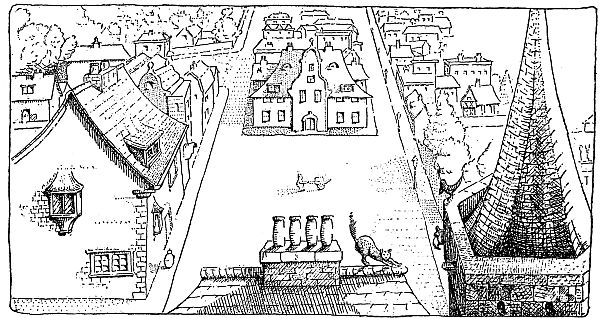 “A little town called Puddleby-on-the-Marsh”
[iii]
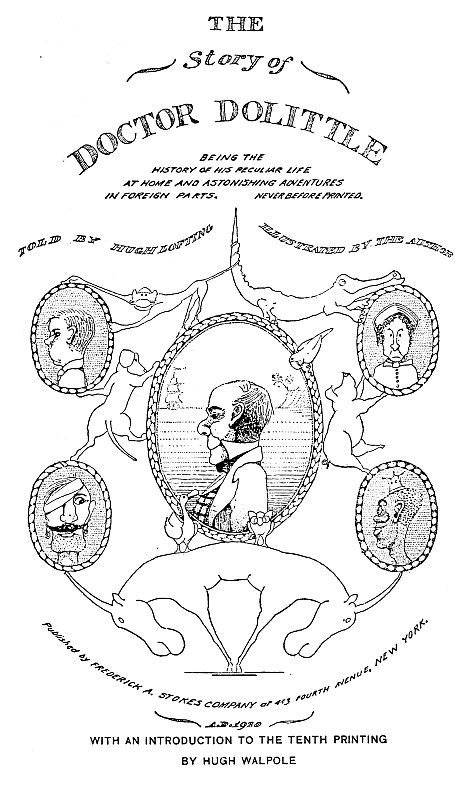 THE
THE
Story of
DOCTOR DOLITTLE
BEING THE
HISTORY OF HIS PECULIAR LIFE
AT HOME AND ASTONISHING ADVENTURES
IN FOREIGN PARTS. NEVER BEFORE PRINTED.
TOLD BY HUGH LOFTING ILLUSTRATED BY THE AUTHOR
Published by FREDERICK A. STOKES COMPANY at 443 FOURTH AVENUE,fantasy figures for 13 year olds under 30 dollars NEW YORK.
A.D. 1920
WITH AN INTRODUCTION TO THE TENTH PRINTING
BY HUGH WALPOLE[iv]
Copyright, 1920, by
Frederick A. Stokes Company
All rights reserved, including that of translation
into foreign languagesFirst Printing, Aug. 24, 1920 Second Printing, Dec. 17, 1920 Third Printing, April 16, 1921 Fourth Printing, July 7, 1921 Fifth Printing, Sept. 1, 1921 Sixth Printing, Oct. 26, 1921 Seventh Printing, Dec. 5, 1921 Eighth Printing, April 3, 1922 Ninth Printing, Aug. 18, 1922 Tenth Printing, Nov. 28, 1922 Eleventh Printing, April 2, 1923
Printed in the United States of America[v]
TO
ALL CHILDREN
CHILDREN IN YEARS AND CHILDREN IN HEART
I DEDICATE THIS STORY[vi]
[vii]INTRODUCTION TO THE TENTHPRINTING
THERE are some of us now reachingmiddle age who discover themselves to be lamentingthe past in one respect if in none other,that there are no books written now for childrencomparable with those of thirty years ago. Isay written forchildren because the new psychologicalbusiness of writing aboutthem as thoughthey were small pills or hatched in some especiallyscientific method is extremely popular to-day.Writing for children rather than aboutthem is very difficult as everybody who has triedit knows. It can only be done, I am convinced,by somebody having a great deal of the childin his own outlook and sensibilities. Such wasthe author of “The Little Duke” and “TheDove in the Eagle’s Nest,” such the author of“A Flatiron for a Farthing,” and “The Storyof a Short Life.” Such, above all, the author of“Alice in Wonderland.” Grownups imaginethat they can do the trick by adopting baby[viii]language and talking down to their very criticalaudience. There never was a greater mistake.The imagination of the author must be a child’simagination and yet maturely consistent, so thatthe White Queen in “Alice,” for instance, isseen just as a child would see her, but she continuesalways herself through all her distressingadventures. The supreme touch of the whiterabbit pulling on his white gloves as he hastensis again absolutely the child’s vision, but thewhite rabbit as guide and introducer of Alice’sadventures belongs to mature grown insight.
Geniuses are rare and, without being at allan undue praiser of times past, one can say withouthesitation that until the appearance of HughLofting, the successor of Miss Yonge, Mrs.Ewing, Mrs. Gatty and Lewis Carroll had notappeared. I remember the delight with whichsome six months ago I picked up the first “Dolittle”book in the Hampshire bookshop atSmith College in Northampton. One of Mr.Lofting’s pictures was quite enough for me.The picture that I lighted upon when I firstopened the book was the one of the monkeys[ix]making a chain with their arms across the gulf.Then I looked further and discovered Bumporeading fairy stories to himself. And thenlooked again and there was a picture of JohnDolittle’s house.
But pictures are not enough although mostauthors draw so badly that if one of them happensto have the genius for line that Mr. Loftingshows there must be, one feels, something in hiswriting as well. There is. You cannot read thefirst paragraph of the book, which begins in theright way “Once upon a time” without knowingthat Mr. Lofting believes in his story quiteas much as he expects you to. That is the firstessential for a story teller. Then you discoveras you read on that he has the right eye for theright detail. What child-inquiring mind couldresist this intriguing sentence to be found on thesecond page of the book:
“Besides the gold-fish in the pond at the bottomof his garden, he had rabbits in the pantry,white mice in his piano, a squirrel in the linencloset and a hedgehog in the cellar.”
[x]
And then when you read a little further youwill discover that the Doctor is not merely apeg on whom to hang exciting and various adventuresbut that he is himself a man of originaland lively character. He is a very kindly, generousman, and anyone who has ever writtenstories will know that it is much more difficultto make kindly, generous characters interestingthan unkindly and mean ones. But Dolittle is interesting.It is not only that he is quaint butthat he is wise and knows what he is about. Thereader, however young, who meets him gets verysoon a sense that if he were in trouble, not necessarilymedical, he would go to Dolittle and askhis advice about it. Dolittle seems to extendhis hand from the page and grasp that of hisreader, and I can see him going down the centuriesa kind of Pied Piper with thousands ofchildren at his heels. But not only is he a darlingand alive and credible but his creator hasalso managed to invest everybody else in thebook with the same kind of life.
Now this business of giving life to animals,making them talk and behave like human[xi]beings, is an extremely difficult one. Lewis Carrollabsolutely conquered the difficulties, but Iam not sure that anyone after him until HughLofting has really managed the trick; even insuch a masterpiece as “The Wind in the Willows”we are not quite convinced. John Dolittle’sfriends are convincing because their creatornever forces them to desert their own characteristics.Polynesia, for instance, is naturalfrom first to last. She really does care aboutthe Doctor but she cares as a bird would care,having always some place to which she is goingwhen her business with her friends is over. Andwhen Mr. Lofting invents fantastic animals hegives them a kind of credible possibility whichis extraordinarily convincing. It will be impossiblefor anyone who has read this book notto believe in the existence of the pushmi-pullyu,who would be credible enough even were thereno drawing of it, but the picture on page 153settles the matter of his truth once and for all.
In fact this book is a work of genius and, asalways with works of genius, it is difficult toanalyze the elements that have gone to make[xii]it. There is poetry here and fantasy and humor,a little pathos but, above all, a number of creationsin whose existence everybody must believewhether they be children of four or old men ofninety or prosperous bankers of forty-five. Idon’t know how Mr. Lofting has done it; Idon’t suppose that he knows himself. There itis—the first real children’s classic since “Alice.”
Hugh Walpole.[xiii]
CONTENTS
Introduction vii CHAPTER PAGE I Puddleby 1 II Animal Language 7 III More Money Troubles 19 IV A Message from Africa 29 V The Great Journey 37 VI Polynesia and the King 47 VII The Bridge of Apes 55 VIII The Leader of the Lions 67 IX The Monkeys’ Council 75 X The Rarest Animal of All 81 XI The Black Prince 91 XII Medicine and Magic 99 XIII Red Sails and Blue Wings 111 XIV The Rats’ Warning 117 XV The Barbary Dragon 125 XVI Too-Too, the Listener 133 XVII The Ocean Gossips 141 XVIII Smells 149 XIX The Rock 159 XX The Fisherman’s Town 167 XXI Home Again 174 [xiv]
[xv]ILLUSTRATIONS
“A little town called Puddleby-on-the-Marsh” Frontispiece PAGE “And she never came to see him any more” 3 “He could see as well as ever” 14 “They came at once to his house on the edge of the town” 15 “They used to sit in chairs on the lawn” 19 “‘All right,’ said the Doctor, ‘go and get married’” 23 “One evening when the Doctor was asleep in his chair” 24 “‘I felt sure there was twopence left’” 31 “And the voyage began” 35 “‘We must have run into Africa’” 41 “‘I got into it because I did not want to be drowned’” 44 “And Queen Ermintrude was asleep” 48 “‘Who’s that?’” 52 “Cheering and waving leaves and swinging out of the branches to greet him” 61 “John Dolittle was the last to cross” 65 “He made all the monkeys who were still well come and be vaccinated” 68 “‘ME, the King of Beasts, to wait on a lot of dirty monkeys?’” 70 “Then the Grand Gorilla got up” 76 [xvi]“‘Lord save us!’ cried the duck. ‘How does it make up its mind?’” 85 “He began reading the fairy-stories to himself” 96 “Crying bitterly and waving till the ship was out of sight” 109 “‘They are surely the pirates of Barbary’” 114 “‘And you have heard that rats always leave a sinking ship?’” 119 “‘Look here, Ben Ali—’” 127 “‘Sh!—Listen!—I do believe there’s someone in there!’” 136 “‘You stupid piece of warm bacon!’” 153 “‘Doctor!’ he cried. ‘I’ve got it!’” 160 “And she kissed the Doctor many times” 170 “The Doctor sat in a chair in front” 176 “He began running round the garden like a crazy thing” 178 [xvii]
THE STORY OF DOCTOR DOLITTLE[1]
THE STORY OF
DOCTOR DOLITTLETHE FIRST CHAPTER
PUDDLEBY
ONCE upon a time, many years ago—whenour grandfathers werelittle children—there was a doctor;and his name was Dolittle—JohnDolittle, M.D. “M.D.”means that he was a proper doctorand knew a whole lot.
He lived in a little town called, Puddleby-on-the-Marsh.All the folks, young and old,knew him well by sight. And whenever hewalked down the street in his high hat everyonewould say, “There goes the Doctor!—He’sa clever man.” And the dogs and the childrenwould all run up and follow behind him; and[2]even the crows that lived in the church-towerwould caw and nod their heads.
The house he lived in, on the edge of thetown, was quite small; but his garden was verylarge and had a wide lawn and stone seats andweeping-willows hanging over. His sister,Sarah Dolittle, was housekeeper for him; butthe Doctor looked after the garden himself.
He was very fond of animals and kept manykinds of pets. Besides the gold-fish in the pondat the bottom of his garden, he had rabbits inthe pantry, white mice in his piano, a squirrelin the linen closet and a hedgehog in the cellar.He had a cow with a calf too, and an old lamehorse—twenty-five years of age—and chickens,and pigeons, and two lambs, and many otheranimals. But his favorite pets were Dab-Dabthe duck, Jip the dog, Gub-Gub the baby pig,Polynesia the parrot, and the owl Too-Too.
His sister used to grumble about all these animalsand said they made the house untidy.And one day when an old lady with rheumatismcame to see the Doctor, she sat on the hedgehogwho was sleeping on the sofa and never came[3]
[4]to see him any more, but drove every Saturdayall the way to Oxenthorpe, another town tenmiles off, to see a different doctor.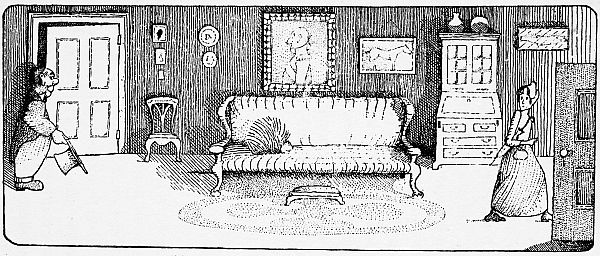 “And she never came to see him any more”
Then his sister, Sarah Dolittle, came to himand said,
“John, how can you expect sick people tocome and see you when you keep all these animalsin the house? It’s a fine doctor would havehis parlor full of hedgehogs and mice! That’sthe fourth personage these animals have drivenaway. Squire Jenkins and the Parson say theywouldn’t come near your house again—no matterhow sick they are. We are getting poorerevery day. If you go on like this, none of thebest people will have you for a doctor.”
“But I like the animals better than the ‘bestpeople’,” said the Doctor.
“You are ridiculous,” said his sister, andwalked out of the room.
So, as time went on, the Doctor got more andmore animals; and the people who came to seehim got less and less. Till at last he had noone left—except the Cat’s-meat-Man, who didn’tmind any kind of animals. But the Cat’s-meat-Man[5]wasn’t very rich and he only got sick oncea year—at Christmas-time, when he used to givethe Doctor sixpence for a bottle of medicine.
Sixpence a year wasn’t enough to live on—evenin those days, long ago; and if the Doctorhadn’t had some money saved up in his money-box,no one knows what would have happened.
And he kept on getting still more pets; and ofcourse it cost a lot to feed them. And the moneyhe had saved up grew littler and littler.
Then he sold his piano, and let the mice livein a bureau-drawer. But the money he got forthat too began to go, so he sold the brown suithe wore on Sundays and went on becomingpoorer and poorer.
And now, when he walked down the streetin his high hat, people would say to one another,“There goes John Dolittle, M.D.! There was atime when he was the best known doctor in theWest Country—Look at him now—He hasn’tany money and his stockings are full of holes!”
But the dogs and the cats and the childrenstill ran up and followed him through the town—thesame as they had done when he was rich.
[6]
[7]THE SECOND CHAPTER
ANIMAL LANGUAGE
IT happened one day that the Doctorwas sitting in his kitchen talkingwith the Cat’s-meat-Manwho had come to see him with astomach-ache.
“Why don’t you give up beinga people’s doctor, and be an animal-doctor?”asked the Cat’s-meat-Man.
The parrot, Polynesia, was sitting in the windowlooking out at the rain and singing a sailor-songto herself. She stopped singing andstarted to listen.
“You see, Doctor,” the Cat’s-meat-Man wenton, “you know all about animals—much morethan what these here vets do. That book youwrote—about cats, why, it’s wonderful! I can’tread or write myself—or maybe I’dwrite somebooks. But my wife, Theodosia, she’s a scholar,[8]she is. And she read your book to me. Well,it’s wonderful—that’s all can be said—wonderful.You might have been a cat yourself. Youknow the way they think. And listen: you canmake a lot of money doctoring animals. Doyou know that? You see, I’d send all the oldwomen who had sick cats or dogs to you. Andif they didn’t get sick fast enough, I could putsomething in the meat I sell ’em to make ’emsick, see?”
“Oh, no,” said the Doctor quickly. “Youmustn’t do that. That wouldn’t be right.”
“Oh, I didn’t mean real sick,” answered theCat’s-meat-Man. “Just a little something tomake them droopy-like was what I had referenceto. But as you say, maybe it ain’t quitefair on the animals. But they’ll get sick anyway,because the old women always give ’em toomuch to eat. And look, all the farmers roundabout who had lame horses and weak lambs—they’dcome. Be an animal-doctor.”
When the Cat’s-meat-Man had gone the parrotflew off the window on to the Doctor’s tableand said,
[9]
“That man’s got sense. That’s what youought to do. Be an animal-doctor. Give thesilly people up—if they haven’t brains enoughto see you’re the best doctor in the world. Takecare of animals instead—they’ll soon find it out.Be an animal-doctor.”
“Oh, there are plenty of animal-doctors,” saidJohn Dolittle, putting the flower-pots outside onthe window-sill to get the rain.
“Yes, there areplenty,” said Polynesia. “Butnone of them are any good at all. Now listen,Doctor, and I’ll tell you something. Did youknow that animals can talk?”
“I knew that parrots can talk,” said the Doctor.
“Oh, we parrots can talk in two languages—people’slanguage and bird-language,” saidPolynesia proudly. “If I say, ‘Polly wants acracker,’ you understand me. But hear this:Ka-ka oi-ee, fee-fee?”
“Good Gracious!” cried the Doctor. “Whatdoes that mean?”
“That means, ‘Is the porridge hot yet?’—inbird-language.”
[10]
“My! You don’t say so!” said the Doctor.“You never talked that way to me before.”
“What would have been the good?” saidPolynesia, dusting some cracker-crumbs off herleft wing. “You wouldn’t have understood meif I had.”
“Tell me some more,” said the Doctor, all excited;and he rushed over to the dresser-drawerand came back with the butcher’s book and apencil. “Now don’t go too fast—and I’ll writeit down. This is interesting—very interesting—somethingquite new. Give me the Birds’A.B.C. first—slowly now.”
So that was the way the Doctor came to knowthat animals had a language of their own andcould talk to one another. And all that afternoon,while it was raining, Polynesia sat on thekitchen table giving him bird words to put downin the book.
At tea-time, when the dog, Jip, came in, theparrot said to the Doctor, “See, he’s talking toyou.”
“Looks to me as though he were scratching hisear,” said the Doctor.
[11]
“But animals don’t always speak with theirmouths,” said the parrot in a high voice, raisingher eyebrows. “They talk with their ears,with their feet, with their tails—with everything.Sometimes they don’t wantto make anoise. Do you see now the way he’s twitchingup one side of his nose?”
“What’s that mean?” asked the Doctor.
“That means, ‘Can’t you see that it hasstopped raining?’” Polynesia answered. “Heis asking you a question. Dogs nearly alwaysuse their noses for asking questions.”
After a while, with the parrot’s help, theDoctor got to learn the language of the animalsso well that he could talk to them himself andunderstand everything they said. Then he gaveup being a people’s doctor altogether.
As soon as the Cat’s-meat-Man had told everyone that John Dolittle was going to become ananimal-doctor, old ladies began to bring himtheir pet pugs and poodles who had eaten toomuch cake; and farmers came many miles toshow him sick cows and sheep.
One day a plow-horse was brought to him;[12]and the poor thing was terribly glad to find aman who could talk in horse-language.
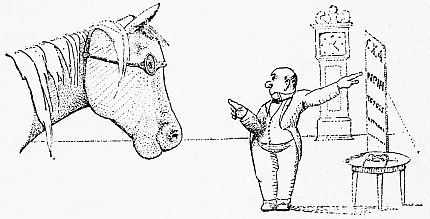
“You know, Doctor,” said the horse, “thatvet over the hill knows nothing at all. He hasbeen treating me six weeks now—for spavins.What I need is spectacles. I am going blind inone eye. There’s no reason why horsesshouldn’t wear glasses, the same as people. Butthat stupid man over the hill never even lookedat my eyes. He kept on giving me big pills.I tried to tell him; but he couldn’t understanda word of horse-language. What I need is spectacles.”
“Of course—of course,” said the Doctor.“I’ll get you some at once.”
“I would like a pair like yours,” said thehorse—“only green. They’ll keep the sun outof my eyes while I’m plowing the Fifty-AcreField.”
“Certainly,” said the Doctor. “Green onesyou shall have.”
“You know, the trouble is, Sir,” said theplow-horse as the Doctor opened the front doorto let him out—“the trouble is that anybody[13]thinks he can doctor animals—just because theanimals don’t complain. As a matter of factit takes a much cleverer man to be a really goodanimal-doctor than it does to be a good people’sdoctor. My farmer’s boy thinks he knows allabout horses. I wish you could see him—hisface is so fat he looks as though he had no eyes—andhe has got as much brain as a potato-bug.He tried to put a mustard-plaster on me lastweek.”
“Where did he put it?” asked the Doctor.
“Oh, he didn’t put it anywhere—on me,” saidthe horse. “He only tried to. I kicked himinto the duck-pond.”
“Well, well!” said the Doctor.
“I’m a pretty quiet creature as a rule,” saidthe horse—“very patient with people—don’tmake much fuss. But it was bad enough tohave that vet giving me the wrong medicine.And when that red-faced booby started tomonkey with me, I just couldn’t bear it anymore.”
“Did you hurt the boy much?” asked the Doctor.
[14]
“Oh, no,” said the horse. “I kicked him inthe right place. The vet’s looking after himnow. When will my glasses be ready?”
“I’ll have them for you next week,” said theDoctor. “Come in again Tuesday—Goodmorning!”
 “He could see as well as ever”
Then John Dolittle got a fine, big pair ofgreen spectacles; and the plow-horse stoppedgoing blind in one eye and could see as well asever.
And soon it became a common sight to seefarm-animals wearing glasses in the countryround Puddleby; and a blind horse was a thingunknown.
[15]
And so it was with all the other animals thatwere brought to him. As soon as they foundthat he could talk their language, they told himwhere the pain was and how they felt, and ofcourse it was easy for him to cure them.
 “They came at once to his house on the edge of the town”
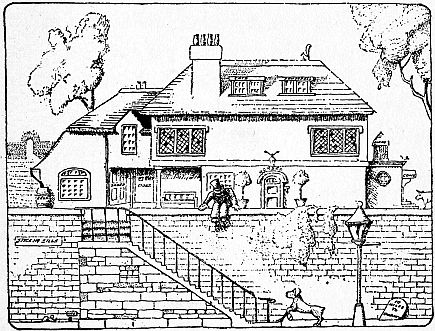
Now all these animals went back and toldtheir brothers and friends that there was a doctorin the little house with the big garden whoreally wasa doctor. And whenever any creaturesgot sick—not only horses and cows and[16]dogs—but all the little things of the fields, likeharvest-mice and water-voles, badgers and bats,they came at once to his house on the edge of thetown, so that his big garden was nearly alwayscrowded with animals trying to get in to seehim.
There were so many that came that he had tohave special doors made for the different kinds.He wrote “HORSES” over the front door,“COWS” over the side door, and “SHEEP” onthe kitchen door. Each kind of animal had aseparate door—even the mice had a tiny tunnelmade for them into the cellar, where theywaited patiently in rows for the Doctor to comeround to them.
And so, in a few years’ time, every livingthing for miles and miles got to know aboutJohn Dolittle, M.D. And the birds who flewto other countries in the winter told the animalsin foreign lands of the wonderful doctorof Puddleby-on-the-Marsh, who could understandtheir talk and help them in their troubles.In this way he became famous among the animals—allover the world—better known even[17]than he had been among the folks of the WestCountry. And he was happy and liked his lifevery much.
One afternoon when the Doctor was busywriting in a book, Polynesia sat in the window—asshe nearly always did—looking out atthe leaves blowing about in the garden. Presentlyshe laughed aloud.
“What is it, Polynesia?” asked the Doctor,looking up from his book.
“I was just thinking,” said the parrot; andshe went on looking at the leaves.
“What were you thinking?”
“I was thinking about people,” said Polynesia.“People make me sick. They think they’re sowonderful. The world has been going on nowfor thousands of years, hasn’t it? And the onlything in animal-language that peoplehavelearned to understand is that when a dog wagshis tail he means ‘I’m glad!’—It’s funny, isn’tit? You are the very first man to talk like us.Oh, sometimes people annoy me dreadfully—suchairs they put on—talking about ‘the dumbanimals.’ Dumb!—Huh! Why I knew a[18]macaw once who could say ‘Good morning!’ inseven different ways without once opening hismouth. He could talk every language—andGreek. An old professor with a gray beardbought him. But he didn’t stay. He said theold man didn’t talk Greek right, and he couldn’tstand listening to him teach the language wrong.I often wonder what’s become of him. Thatbird knew more geography than people will everknow.—People, Golly! I suppose if peopleever learn to fly—like any common hedge-sparrow—weshall never hear the end of it!”
“You’re a wise old bird,” said the Doctor.“How old are you really? I know that parrotsand elephants sometimes live to be very, veryold.”
“I can never be quite sure of my age,” saidPolynesia. “It’s either a hundred and eighty-threeor a hundred and eighty-two. But Iknow that when I first came here from Africa,King Charles was still hiding in the oak-tree—becauseI saw him. He looked scared todeath.”
[19]
THE THIRD CHAPTER
MORE MONEY TROUBLES
AND soon now the Doctorbegan to make moneyagain; and his sister,Sarah, bought a newdress and was happy.
Some of the animalswho came to see him were so sick that they hadto stay at the Doctor’s house for a week. Andwhen they were getting better they used to sit inchairs on the lawn.
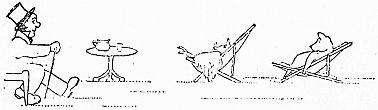 “They used to sit in chairs on the lawn”
And often even after they got well, they didnot want to go away—they liked the Doctor[20]and his house so much. And he never had theheart to refuse them when they asked if theycould stay with him. So in this way he wenton getting more and more pets.
Once when he was sitting on his garden wall,smoking a pipe in the evening, an Italian organ-grindercame round with a monkey on a string.The Doctor saw at once that the monkey’s collarwas too tight and that he was dirty and unhappy.So he took the monkey away from theItalian, gave the man a shilling and told himto go. The organ-grinder got awfully angryand said that he wanted to keep the monkey.But the Doctor told him that if he didn’t goaway he would punch him on the nose. JohnDolittle was a strong man, though he wasn’tvery tall. So the Italian went away saying rudethings and the monkey stayed with Doctor Dolittleand had a good home. The other animalsin the house called him “Chee-Chee”—whichis a common word in monkey-language,meaning “ginger.”
And another time, when the circus came toPuddleby, the crocodile who had a bad toothache[21]escaped at night and came into the Doctor’sgarden. The Doctor talked to him incrocodile-language and took him into the houseand made his tooth better. But when the crocodilesaw what a nice house it was—with all thedifferent places for the different kinds of animals—hetoo wanted to live with the Doctor.He asked couldn’t he sleep in the fish-pond atthe bottom of the garden, if he promised notto eat the fish. When the circus-men came totake him back he got so wild and savage thathe frightened them away. But to every one inthe house he was always as gentle as a kitten.
But now the old ladies grew afraid to sendtheir lap-dogs to Doctor Dolittle because of thecrocodile; and the farmers wouldn’t believe thathe would not eat the lambs and sick calves theybrought to be cured. So the Doctor went tothe crocodile and told him he must go backto his circus. But he wept such big tears, andbegged so hard to be allowed to stay, that theDoctor hadn’t the heart to turn him out.
So then the Doctor’s sister came to him andsaid,
[22]
“John, you must send that creature away.Now the farmers and the old ladies are afraidto send their animals to you—just as we werebeginning to be well off again. Now we shallbe ruined entirely. This is the last straw. Iwill no longer be housekeeper for you if youdon’t send away that alligator.”
“It isn’t an alligator,” said the Doctor—“it’sa crocodile.”
“I don’t care what you call it,” said his sister.“It’s a nasty thing to find under the bed. Iwon’t have it in the house.”
“But he has promised me,” the Doctor answered,“that he will not bite any one. Hedoesn’t like the circus; and I haven’t the moneyto send him back to Africa where he comesfrom. He minds his own business and on thewhole is very well behaved. Don’t be sofussy.”
“I tell you I will nothave him around,” saidSarah. “He eats the linoleum. If you don’tsend him away this minute I’ll—I’ll go and getmarried!”
“All right,” said the Doctor, “go and get married.[23]It can’t be helped.” And he took downhis hat and went out into the garden.
So Sarah Dolittle packed up her things andwent off; and the Doctor was left all alone withhis animal family.
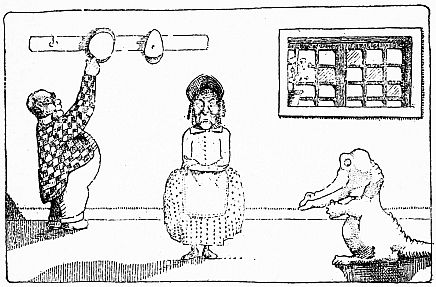 “‘All right,’ said the Doctor, ‘go and get married’”
And very soon he was poorer than he hadever been before. With all these mouths to fill,and the house to look after, and no one to dothe mending, and no money coming in to paythe butcher’s bill, things began to look very difficult.But the Doctor didn’t worry at all.
[24]
“Money is a nuisance,” he used to say.“We’d all be much better off if it had neverbeen invented. What does money matter, solong as we are happy?”
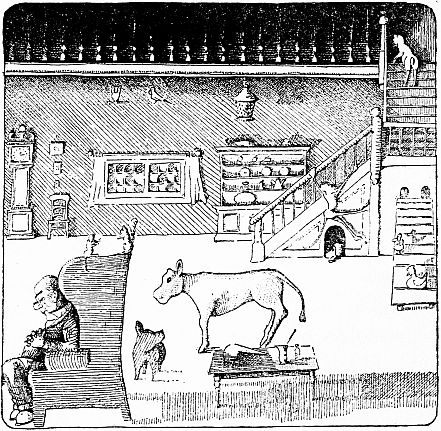 “One evening when the Doctor was asleep in his chair”
But soon the animals themselves began to getworried. And one evening when the Doctorwas asleep in his chair before the kitchen-fire[25]they began talking it over among themselves inwhispers. And the owl, Too-Too, who wasgood at arithmetic, figured it out that there wasonly money enough left to last another week—ifthey each had one meal a day and no more.
Then the parrot said, “I think we all oughtto do the housework ourselves. At least we cando that much. After all, it is for our sakes thatthe old man finds himself so lonely and sopoor.”
So it was agreed that the monkey, Chee-Chee,was to do the cooking and mending; the dogwas to sweep the floors; the duck was to dustand make the beds; the owl, Too-Too, was tokeep the accounts, and the pig was to do thegardening. They made Polynesia, the parrot,housekeeper and laundress, because she was theoldest.
Of course at first they all found their newjobs very hard to do—all except Chee-Chee, whohad hands, and could do things like a man. Butthey soon got used to it; and they used to thinkit great fun to watch Jip, the dog, sweepinghis tail over the floor with a rag tied onto it for[26]a broom. After a little they got to do the workso well that the Doctor said that he had neverhad his house kept so tidy or so clean before.
In this way things went along all right for awhile; but without money they found it veryhard.
Then the animals made a vegetable and flowerstall outside the garden-gate and sold radishesand roses to the people that passed by along theroad.
But still they didn’t seem to make enoughmoney to pay all the bills—and still the Doctorwouldn’t worry. When the parrot came tohim and told him that the fishmonger wouldn’tgive them any more fish, he said,
“Never mind. So long as the hens lay eggsand the cow gives milk we can have omelettesand junket. And there are plenty of vegetablesleft in the garden. The Winter is still a longway off. Don’t fuss. That was the troublewith Sarah—she would fuss. I wonder howSarah’s getting on—an excellent woman—insome ways—Well, well!”
But the snow came earlier than usual that[27]year; and although the old lame horse hauledin plenty of wood from the forest outside thetown, so they could have a big fire in the kitchen,most of the vegetables in the garden were gone,and the rest were covered with snow; and manyof the animals were really hungry.
[28]
[29]THE FOURTH CHAPTER
A MESSAGE FROM AFRICA
THAT Winter was a very coldone. And one night in December,when they were all sittinground the warm fire in thekitchen, and the Doctor wasreading aloud to them out ofbooks he had written himself in animal-language,the owl, Too-Too, suddenly said,
“Sh! What’s that noise outside?”
They all listened; and presently they heardthe sound of some one running. Then the doorflew open and the monkey, Chee-Chee, ran in,badly out of breath.
“Doctor!” he cried, “I’ve just had a messagefrom a cousin of mine in Africa. There is aterrible sickness among the monkeys out there.They are all catching it—and they are dyingin hundreds. They have heard of you, and begyou to come to Africa to stop the sickness.”
[30]
“Who brought the message?” asked the Doctor,taking off his spectacles and laying downhis book.
“A swallow,” said Chee-Chee. “She is outsideon the rain-butt.”
“Bring her in by the fire,” said the Doctor.“She must be perished with the cold. The swallowsflew South six weeks ago!”
So the swallow was brought in, all huddledand shivering; and although she was a littleafraid at first, she soon got warmed up and saton the edge of the mantelpiece and began totalk.
When she had finished the Doctor said,
“I would gladly go to Africa—especially inthis bitter weather. But I’m afraid we haven’tmoney enough to buy the tickets. Get me themoney-box, Chee-Chee.”
So the monkey climbed up and got it off thetop shelf of the dresser.
There was nothing in it—not one singlepenny!
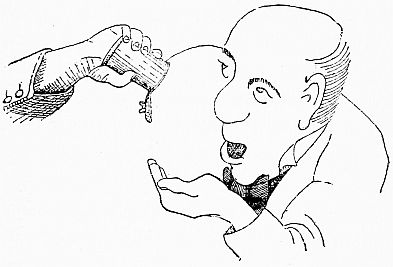
“I felt sure there was twopence left,” said theDoctor.
[31]
“There was” said the owl. “But you spentit on a rattle for that badger’s baby when hewas teething.”
“Did I?” said the Doctor—“dear me, dearme! What a nuisance money is, to be sure!Well, never mind. Perhaps if I go down tothe seaside I shall be able to borrow a boat thatwill take us to Africa. I knew a seaman oncewho brought his baby to me with measles.Maybe he’ll lend us his boat—the baby gotwell.”
 “‘I felt sure there was twopence left’”
So early the next morning the Doctor wentdown to the sea-shore. And when he came back[32]he told the animals it was all right—the sailorwas going to lend them the boat.
Then the crocodile and the monkey and theparrot were very glad and began to sing, becausethey were going back to Africa, their realhome. And the Doctor said,
“I shall only be able to take you three—withJip the dog, Dab-Dab the duck, Gub-Gub thepig and the owl, Too-Too. The rest of the animals,like the dormice and the water-voles andthe bats, they will have to go back and live inthe fields where they were born till we comehome again. But as most of them sleep throughthe Winter, they won’t mind that—and besides,it wouldn’t be good for them to go to Africa.”
So then the parrot, who had been on long sea-voyagesbefore, began telling the Doctor all thethings he would have to take with him on theship.
“You must have plenty of pilot-bread,” shesaid—“‘hard tack’ they call it. And you musthave beef in cans—and an anchor.”
“I expect the ship will have its own anchor,”said the Doctor.
[33]
“Well, make sure,” said Polynesia. “Becauseit’s very important. You can’t stop if youhaven’t got an anchor. And you’ll need abell.”
“What’s that for?” asked the Doctor.
“To tell the time by,” said the parrot. “Yougo and ring it every half-hour and then youknow what time it is. And bring a whole lot ofrope—it always comes in handy on voyages.”
Then they began to wonder where they weregoing to get the money from to buy all thethings they needed.
“Oh, bother it! Money again,” cried theDoctor. “Goodness! I shall be glad to get toAfrica where we don’t have to have any! I’llgo and ask the grocer if he will wait for hismoney till I get back—No, I’ll send the sailorto ask him.”
So the sailor went to see the grocer. Andpresently he came back with all the things theywanted.
Then the animals packed up; and after theyhad turned off the water so the pipes wouldn’tfreeze, and put up the shutters, they closed the[34]house and gave the key to the old horse wholived in the stable. And when they had seenthat there was plenty of hay in the loft to lastthe horse through the Winter, they carried alltheir luggage down to the seashore and got onto the boat.
The Cat’s-meat-Man was there to see themoff; and he brought a large suet-pudding as apresent for the Doctor because, he said he hadbeen told, you couldn’t get suet-puddings in foreignparts.
As soon as they were on the ship, Gub-Gub,the pig, asked where the beds were, for it wasfour o’clock in the afternoon and he wantedhis nap. So Polynesia took him downstairs intothe inside of the ship and showed him the beds,set all on top of one another like book-shelvesagainst a wall.
“Why, that isn’t a bed!” cried Gub-Gub.“That’s a shelf!”
“Beds are always like that on ships,” said theparrot. “It isn’t a shelf. Climb up into it andgo to sleep. That’s what you call ‘a bunk.’”
“I don’t think I’ll go to bed yet,” said Gub-Gub.[35]
[36]“I’m too excited. I want to go upstairsagain and see them start.”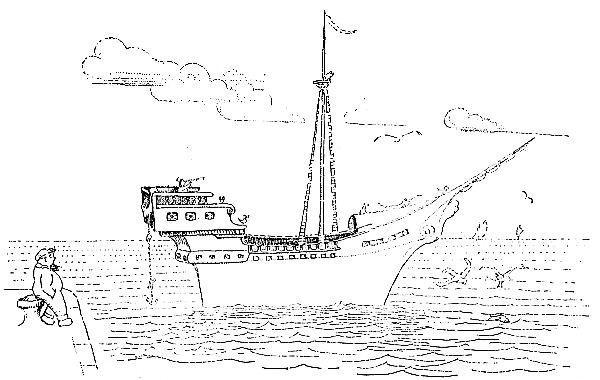 “And the voyage began”
“Well, this is your first trip,” said Polynesia.“You will get used to the life after a while.”And she went back up the stairs of the ship,humming this song to herself,
I’ve seen the Black Sea and the Red Sea;I rounded the Isle of Wight;I discovered the Yellow River,And the Orange too—by night.Now Greenland drops behind again,And I sail the ocean Blue.I’m tired of all these colors, Jane,So I’m coming back to you.They were just going to start on their journey,when the Doctor said he would have to go backand ask the sailor the way to Africa.
But the swallow said she had been to thatcountry many times and would show them howto get there.
So the Doctor told Chee-Chee to pull up theanchor and the voyage began.
[37]
THE FIFTH CHAPTER
THE GREAT JOURNEY
NOW for six whole weeks theywent sailing on and on, overthe rolling sea, following theswallow who flew before theship to show them the way.At night she carried a tinylantern, so they should not miss her in the dark;and the people on the other ships that passedsaid that the light must be a shooting star.
As they sailed further and further into theSouth, it got warmer and warmer. Polynesia,Chee-Chee and the crocodile enjoyed the hotsun no end. They ran about laughing and lookingover the side of the ship to see if they couldsee Africa yet.
But the pig and the dog and the owl, Too-Too,could do nothing in such weather, butsat at the end of the ship in the shade of a big[38]barrel, with their tongues hanging out, drinkinglemonade.
Dab-Dab, the duck, used to keep herself coolby jumping into the sea and swimming behindthe ship. And every once in a while, whenthe top of her head got too hot, she would diveunder the ship and come up on the other side.In this way, too, she used to catch herrings onTuesdays and Fridays—when everybody on theboat ate fish to make the beef last longer.
When they got near to the Equator they sawsome flying-fishes coming towards them. Andthe fishes asked the parrot if this was DoctorDolittle’s ship. When she told them it was, theysaid they were glad, because the monkeys inAfrica were getting worried that he would nevercome. Polynesia asked them how many milesthey had yet to go; and the flying-fishes saidit was only fifty-five miles now to the coast ofAfrica.
And another time a whole school of porpoisescame dancing through the waves; and they tooasked Polynesia if this was the ship of the famous[39]doctor. And when they heard that it was,they asked the parrot if the Doctor wanted anythingfor his journey.
And Polynesia said, “Yes. We have runshort of onions.”
“There is an island not far from here,” saidthe porpoises, “where the wild onions grow talland strong. Keep straight on—we will getsome and catch up to you.”
So the porpoises dashed away through thesea. And very soon the parrot saw them again,coming up behind, dragging the onions throughthe waves in big nets made of seaweed.
The next evening, as the sun was going down,the Doctor said,
“Get me the telescope, Chee-Chee. Ourjourney is nearly ended. Very soon we shouldbe able to see the shores of Africa.”
And about half an hour later, sure enough,they thought they could see something in frontthat might be land. But it began to get darkerand darker and they couldn’t be sure.
Then a great storm came up, with thunder[40]and lightning. The wind howled; the raincame down in torrents; and the waves got sohigh they splashed right over the boat.
Presently there was a big BANG! The shipstopped and rolled over on its side.
“What’s happened?” asked the Doctor, comingup from downstairs.
“I’m not sure,” said the parrot; “but I thinkwe’re ship-wrecked. Tell the duck to get outand see.”
So Dab-Dab dived right down under thewaves. And when she came up she said theyhad struck a rock; there was a big hole in thebottom of the ship; the water was coming in;and they were sinking fast.
“We must have run into Africa,” said theDoctor. “Dear me, dear me!—Well—we mustall swim to land.”
But Chee-Chee and Gub-Gub did not knowhow to swim.
“Get the rope!” said Polynesia. “I told youit would come in handy. Where’s that duck?Come here, Dab-Dab. Take this end of therope, fly to the shore and tie it on to a palm-tree;[41]and we’ll hold the other end on the shiphere. Then those that can’t swim must climbalong the rope till they reach the land. That’swhat you call a ‘life-line.’”
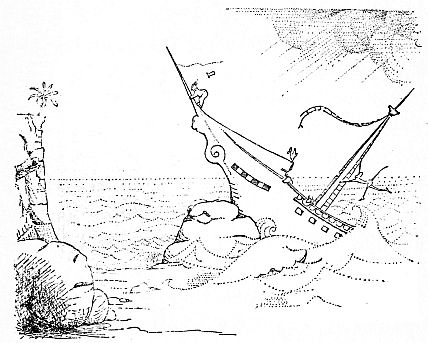 “‘We must have run into Africa’”
So they all got safely to the shore—some swimming,some flying; and those that climbed alongthe rope brought the Doctor’s trunk and hand-bagwith them.
But the ship was no good any more—with the[42]big hole in the bottom; and presently the roughsea beat it to pieces on the rocks and the timbersfloated away.
Then they all took shelter in a nice dry cavethey found, high up in the cliffs, till the stormwas over.
When the sun came out next morning theywent down to the sandy beach to dry themselves.
“Dear old Africa!” sighed Polynesia. “It’sgood to get back. Just think—it’ll be a hundredand sixty-nine years to-morrow since I washere! And it hasn’t changed a bit!—Same oldpalm-trees; same old red earth; same old blackants! There’s no place like home!”
And the others noticed she had tears in hereyes—she was so pleased to see her country onceagain.
Then the Doctor missed his high hat; for ithad been blown into the sea during the storm.So Dab-Dab went out to look for it. And presentlyshe saw it, a long way off, floating on thewater like a toy-boat.
When she flew down to get it, she found one[43]of the white mice, very frightened, sitting insideit.
“What are you doing here?” asked the duck.“You were told to stay behind in Puddleby.”
“I didn’t want to be left behind,” said themouse. “I wanted to see what Africa was like—Ihave relatives there. So I hid in the baggageand was brought on to the ship with thehard-tack. When the ship sank I was terriblyfrightened—because I cannot swim far. Iswam as long as I could, but I soon got all exhaustedand thought I was going to sink. Andthen, just at that moment, the old man’s hat camefloating by; and I got into it because I did notwant to be drowned.”
So the duck took up the hat with the mouse init and brought it to the Doctor on the shore.And they all gathered round to have a look.
“That’s what you call a ‘stowaway,’” said theparrot.
Presently, when they were looking for a placein the trunk where the white mouse could travelcomfortably, the monkey, Chee-Chee, suddenlysaid,
[44]
“Sh! I hear footsteps in the jungle!”
They all stopped talking and listened. Andsoon a black man came down out of the woodsand asked them what they were doing there.
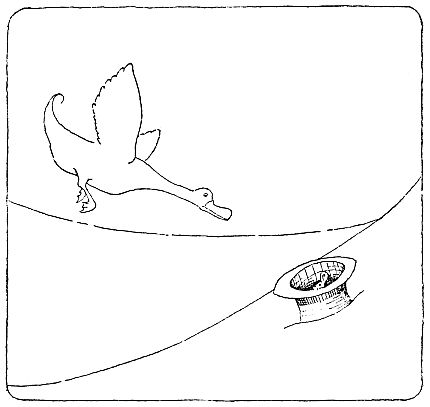 “‘I got into it because I did not want to be drowned’”
“My name is John Dolittle—M.D.,” said theDoctor. “I have been asked to come to Africato cure the monkeys who are sick.”
[45]
“You must all come before the King,” said theblack man.
“What king?” asked the Doctor, who didn’twant to waste any time.
“The King of the Jolliginki,” the man answered.“All these lands belong to him; and allstrangers must be brought before him. Followme.”
So they gathered up their baggage and wentoff, following the man through the jungle.
[46]
[47]THE SIXTH CHAPTER
POLYNESIA AND THE KING
WHEN they hadgone a littleway throughthe thick forest,they cameto a wide, clearspace; and they saw the King’s palace which wasmade of mud.
This was where the King lived with hisQueen, Ermintrude, and their son, PrinceBumpo. The Prince was away fishing for salmonin the river. But the King and Queenwere sitting under an umbrella before the palacedoor. And Queen Ermintrude was asleep.
When the Doctor had come up to the palacethe King asked him his business; and the Doctortold him why he had come to Africa.
“You may not travel through my lands,” saidthe King. “Many years ago a white man came[48]to these shores; and I was very kind to him.But after he had dug holes in the ground to getthe gold, and killed all the elephants to get theirivory tusks, he went away secretly in his ship—without so much as saying ‘Thank you.’ Neveragain shall a white man travel through the landsof Jolliginki.”
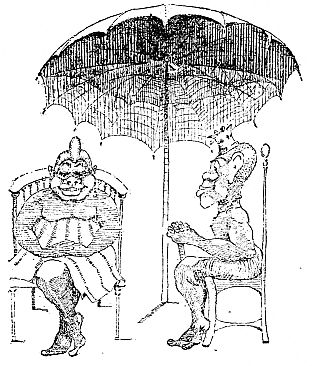 “And Queen Ermintrude was asleep”
Then the King turned to some of the blackmen who were standing near and said, “Take[49]away this medicine-man—with all his animals,and lock them up in my strongest prison.”
So six of the black men led the Doctor andall his pets away and shut them up in a stonedungeon. The dungeon had only one little window,high up in the wall, with bars in it; andthe door was strong and thick.
Then they all grew very sad; and Gub-Gub,the pig, began to cry. But Chee-Chee said hewould spank him if he didn’t stop that horriblenoise; and he kept quiet.
“Are we all here?” asked the Doctor, afterhe had got used to the dim light.
“Yes, I think so,” said the duck and startedto count them.
“Where’s Polynesia?” asked the crocodile.“She isn’t here.”
“Are you sure?” said the Doctor. “Lookagain. Polynesia! Polynesia! Where areyou?”
“I suppose she escaped,” grumbled the crocodile.“Well, that’s just like her!—Sneaked offinto the jungle as soon as her friends got intotrouble.”
[50]
“I’m not that kind of a bird,” said the parrot,climbing out of the pocket in the tail of theDoctor’s coat. “You see, I’m small enough toget through the bars of that window; and I wasafraid they would put me in a cage instead.So while the King was busy talking, I hid inthe Doctor’s pocket—and here I am! That’swhat you call a ‘ruse,’” she said, smoothingdown her feathers with her beak.
“Good Gracious!” cried the Doctor.“You’re lucky I didn’t sit on you.”
“Now listen,” said Polynesia, “to-night, assoon as it gets dark, I am going to creep throughthe bars of that window and fly over to thepalace. And then—you’ll see—I’ll soon finda way to make the King let us all out of prison.”
“Oh, what can youdo?” said Gub-Gub, turningup his nose and beginning to cry again.“You’re only a bird!”
“Quite true,” said the parrot. “But do notforget that although I am only a bird, I can talklike a man—and I know these darkies.”
So that night, when the moon was shiningthrough the palm-trees and all the King’s men[51]were asleep, the parrot slipped out through thebars of the prison and flew across to the palace.The pantry window had been broken by a tennisball the week before; and Polynesia poppedin through the hole in the glass.
She heard Prince Bumpo snoring in his bedroomat the back of the palace. Then she tip-toedup the stairs till she came to the King’sbedroom. She opened the door gently andpeeped in.
The Queen was away at a dance that nightat her cousin’s; but the King was in bed fastasleep.
Polynesia crept in, very softly, and got underthe bed.
Then she coughed—just the way Doctor Dolittleused to cough. Polynesia could mimicany one.
The King opened his eyes and said sleepily:“Is that you, Ermintrude?” (He thought itwas the Queen come back from the dance.)
Then the parrot coughed again—loud, like aman. And the King sat up, wide awake, andsaid, “Who’s that?”
[52]
“I am Doctor Dolittle,” said the parrot—justthe way the Doctor would have said it.
“What are you doing in my bedroom?” criedthe King. “How dare you get out of prison!Where are you?—I don’t see you.”
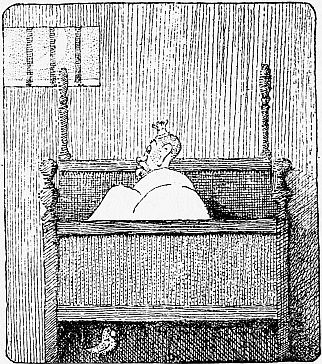 “‘Who’s that?’”
But the parrot just laughed—a long, deep,jolly laugh, like the Doctor’s.
“Stop laughing and come here at once, so Ican see you,” said the King.
[53]
“Foolish King!” answered Polynesia. “Haveyou forgotten that you are talking to John Dolittle,M.D.—the most wonderful man on earth?Of course you cannot see me. I have made myselfinvisible. There is nothing I cannot do.Now listen: I have come here to-night to warnyou. If you don’t let me and my animals travelthrough your kingdom, I will make you and allyour people sick like the monkeys. For I canmake people well: and I can make people ill—justby raising my little finger. Send your soldiersat once to open the dungeon door, or youshall have mumps before the morning sun hasrisen on the hills of Jolliginki.”
Then the King began to tremble and was verymuch afraid.
“Doctor,” he cried, “it shall be as you say.Do not raise your little finger, please!” And hejumped out of bed and ran to tell the soldiersto open the prison door.
As soon as he was gone, Polynesia crept downstairsand left the palace by the pantry window.
But the Queen, who was just letting herselfin at the backdoor with a latch-key, saw the parrot[54]getting out through the broken glass. Andwhen the King came back to bed she told himwhat she had seen.
Then the King understood that he had beentricked, and he was dreadfully angry. He hurriedback to the prison at once.
But he was too late. The door stood open.The dungeon was empty. The Doctor and allhis animals were gone.
[55]
THE SEVENTH CHAPTER
THE BRIDGE OF APES
QUEEN ERMINTRUDE hadnever in her life seen her husbandso terrible as he got thatnight. He gnashed his teethwith rage. He called everybodya fool. He threw histooth-brush at the palace cat. He rushed roundin his night-shirt and woke up all his army andsent them into the jungle to catch the Doctor.Then he made all his servants go too—his cooksand his gardeners and his barber and PrinceBumpo’s tutor—even the Queen, who was tiredfrom dancing in a pair of tight shoes, was packedoff to help the soldiers in their search.
All this time the Doctor and his animals wererunning through the forest towards the Land ofthe Monkeys as fast as they could go.
Gub-Gub, with his short legs, soon got tired;and the Doctor had to carry him—which made[56]it pretty hard when they had the trunk and thehand-bag with them as well.
The King of the Jolliginki thought it wouldbe easy for his army to find them, because theDoctor was in a strange land and would notknow his way. But he was wrong; because themonkey, Chee-Chee, knew all the paths throughthe jungle—better even than the King’s men did.And he led the Doctor and his pets to the verythickest part of the forest—a place where noman had ever been before—and hid them all ina big hollow tree between high rocks.
“We had better wait here,” said Chee-Chee,“till the soldiers have gone back to bed. Thenwe can go on into the Land of the Monkeys.”
So there they stayed the whole night through.
They often heard the King’s men searchingand talking in the jungle round about. Butthey were quite safe, for no one knew of thathiding-place but Chee-Chee—not even the othermonkeys.
At last, when daylight began to come throughthe thick leaves overhead, they heard QueenErmintrude saying in a very tired voice that it[57]was no use looking any more—that they mightas well go back and get some sleep.
As soon as the soldiers had all gone home,Chee-Chee brought the Doctor and his animalsout of the hiding-place and they set off for theLand of the Monkeys.
It was a long, long way; and they often gotvery tired—especially Gub-Gub. But when hecried they gave him milk out of the cocoanuts,which he was very fond of.
They always had plenty to eat and drink; becauseChee-Chee and Polynesia knew all thedifferent kinds of fruits and vegetables that growin the jungle, and where to find them—likedates and figs and ground-nuts and ginger andyams. They used to make their lemonade out ofthe juice of wild oranges, sweetened with honeywhich they got from the bees’ nests in hollowtrees. No matter what it was they askedfor, Chee-Chee and Polynesia always seemed tobe able to get it for them—or something like it.They even got the Doctor some tobacco one day,when he had finished what he had brought withhim and wanted to smoke.
[58]
At night they slept in tents made of palm-leaves,on thick, soft beds of dried grass. Andafter a while they got used to walking such a lotand did not get so tired and enjoyed the life oftravel very much.
But they were always glad when the nightcame and they stopped for their resting-time.Then the Doctor used to make a little fire ofsticks; and after they had had their supper, theywould sit round it in a ring, listening to Polynesiasinging songs about the sea, or to Chee-Cheetelling stories of the jungle.
And many of the tales that Chee-Chee toldwere very interesting. Because although themonkeys had no history-books of their own beforeDoctor Dolittle came to write them forthem, they remember everything that happens bytelling stories to their children. And Chee-Cheespoke of many things his grandmother had toldhim—tales of long, long, long ago, before Noahand the Flood,—of the days when men dressedin bear-skins and lived in holes in the rock andate their mutton raw, because they did not knowwhat cooking was—having never seen a fire.[59]And he told them of the Great Mammoths andLizards, as long as a train, that wandered overthe mountains in those times, nibbling from thetree-tops. And often they got so interestedlistening, that when he had finished they foundtheir fire had gone right out; and they had toscurry round to get more sticks and build a newone.
Now when the King’s army had gone backand told the King that they couldn’t find theDoctor, the King sent them out again and toldthem they must stay in the jungle till they caughthim. So all this time, while the Doctor and hisanimals were going along towards the Land ofthe Monkeys, thinking themselves quite safe,they were still being followed by the King’s men.If Chee-Chee had known this, he would mostlikely have hidden them again. But he didn’tknow it.
One day Chee-Chee climbed up a high rockand looked out over the tree-tops. And whenhe came down he said they were now quite closeto the Land of the Monkeys and would soonbe there.
[60]
And that same evening, sure enough, they sawChee-Chee’s cousin and a lot of other monkeys,who had not yet got sick, sitting in the trees bythe edge of a swamp, looking and waiting forthem. And when they saw the famous doctorreally come, these monkeys made a tremendousnoise, cheering and waving leaves and swingingout of the branches to greet him.
They wanted to carry his bag and his trunkand everything he had—and one of the biggerones even carried Gub-Gub who had got tiredagain. Then two of them rushed on in front totell the sick monkeys that the great doctor hadcome at last.
But the King’s men, who were still following,had heard the noise of the monkeys cheering;and they at last knew where the Doctor was,and hastened on to catch him.
The big monkey carrying Gub-Gub was comingalong behind slowly, and he saw the Captainof the army sneaking through the trees.So he hurried after the Doctor and told him torun.
Then they all ran harder than they had ever[61]
[62]run in their lives; and the King’s men, comingafter them, began to run too; and the Captainran hardest of all.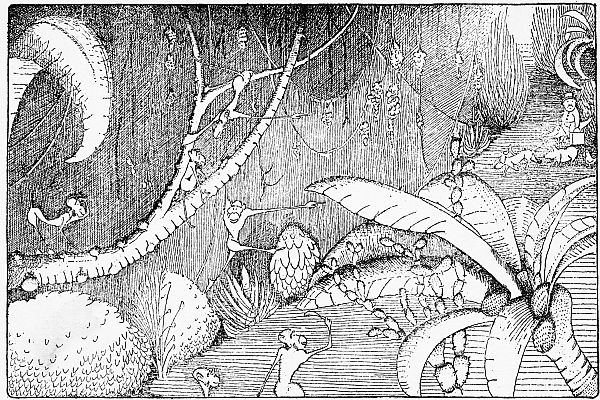 “Cheering and waving leaves and swinging out of the branches to greet him”
Then the Doctor tripped over his medicine-bagand fell down in the mud, and the Captainthought he would surely catch him this time.
But the Captain had very long ears—thoughhis hair was very short. And as he sprang forwardto take hold of the Doctor, one of his earscaught fast in a tree; and the rest of the armyhad to stop and help him.
By this time the Doctor had picked himselfup, and on they went again, running and running.And Chee-Chee shouted,
“It’s all right! We haven’t far to go now!”
But before they could get into the Land ofthe Monkeys, they came to a steep cliff with ariver flowing below. This was the end of theKingdom of Jolliginki; and the Land of theMonkeys was on the other side—across theriver.
And Jip, the dog, looked down over the edgeof the steep, steep cliff and said,
[63]
“Golly! How are we ever going to getacross?”
“Oh, dear!” said Gub-Gub. “The King’smen are quite close now—Look at them! I amafraid we are going to be taken back to prisonagain.” And he began to weep.
But the big monkey who was carrying thepig dropped him on the ground and cried outto the other monkeys,
“Boys—a bridge! Quick!—Make a bridge!We’ve only a minute to do it. They’ve got theCaptain loose, and he’s coming on like a deer.Get lively! A bridge! A bridge!”
The Doctor began to wonder what they weregoing to make a bridge out of, and he gazedaround to see if they had any boards hidden anyplace.
But when he looked back at the cliff, there,hanging across the river, was a bridge all readyfor him—made of living monkeys! For whilehis back was turned, the monkeys—quick as aflash—had made themselves into a bridge, justby holding hands and feet.
[64]
And the big one shouted to the Doctor, “Walkover! Walk over—all of you—hurry!”
Gub-Gub was a bit scared, walking on sucha narrow bridge at that dizzy height above theriver. But he got over all right; and so did allof them.
John Dolittle was the last to cross. And justas he was getting to the other side, the King’smen came rushing up to the edge of the cliff.
Then they shook their fists and yelled withrage. For they saw they were too late. TheDoctor and all his animals were safe in the Landof the Monkeys and the bridge was pulled acrossto the other side.
Then Chee-Chee turned to the Doctor andsaid,
“Many great explorers and gray-beardednaturalists have lain long weeks hidden in thejungle waiting to see the monkeys do that trick.But we never let a white man get a glimpse of itbefore. You are the first to see the famous‘Bridge of Apes.’”
And the Doctor felt very pleased.
[65]
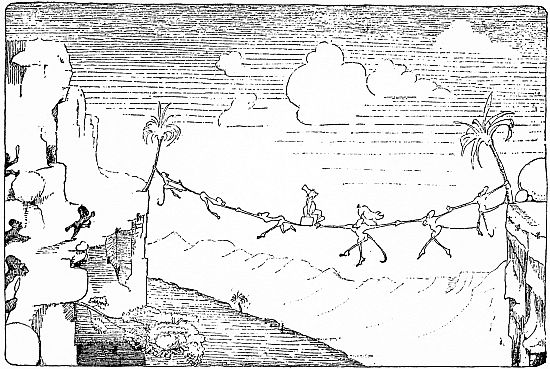 “John Dolittle was the last to cross”
[66]
[67]THE EIGHTH CHAPTER
THE LEADER OF THE LIONS
JOHN DOLITTLE now becamedreadfully, awfully busy. Hefound hundreds and thousands ofmonkeys sick—gorillas, orang-outangs,chimpanzees, dog-faced baboons,marmosettes, gray monkeys,red ones—all kinds. And many had died.
The first thing he did was to separate thesick ones from the well ones. Then he gotChee-Chee and his cousin to build him a littlehouse of grass. The next thing: he made allthe monkeys who were still well come and bevaccinated.
And for three days and three nights themonkeys kept coming from the jungles and thevalleys and the hills to the little house of grass,where the Doctor sat all day and all night, vaccinatingand vaccinating.
[68]
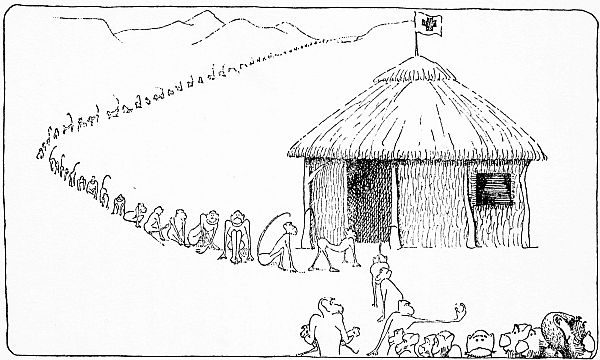 “He made all the monkeys who were still well come and be vaccinated”
[69]
Then he had another house made—a big one,with a lot of beds in it; and he put all the sickones in this house.
But so many were sick, there were not enoughwell ones to do the nursing. So he sent messagesto the other animals, like the lions and theleopards and the antelopes, to come and helpwith the nursing.
But the Leader of the Lions was a very proudcreature. And when he came to the Doctor’sbig house full of beds he seemed angry andscornful.
“Do you dare to ask me, Sir?” he said, glaringat the Doctor. “Do you dare to ask me—ME,the King of Beasts, to wait on a lot of dirtymonkeys? Why, I wouldn’t even eat them betweenmeals!”
Although the lion looked very terrible, theDoctor tried hard not to seem afraid of him.
“I didn’t ask you to eat them,” he said quietly.“And besides, they’re not dirty. They’ve allhad a bath this morning. Yourcoat looks asthough it needed brushing—badly. Nowlisten, and I’ll tell you something: the day may[70]come when the lions get sick. And if you don’thelp the other animals now, the lions may findthemselves left all alone when theyare introuble. That often happens to proud people.”
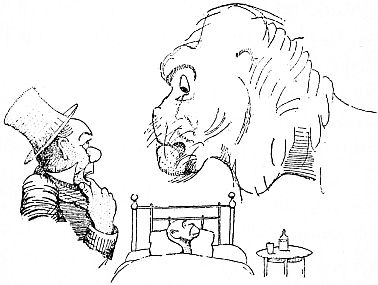 “‘ME, the King of Beasts, to wait on a lot of dirtymonkeys?’”
“The lions are never introuble—they onlymaketrouble,” said the Leader, turning up hisnose. And he stalked away into the jungle, feelinghe had been rather smart and clever.
Then the leopards got proud too and saidthey wouldn’t help. And then of course the[71]antelopes—although they were too shy and timidto be rude to the Doctor like the lion—theypawed the ground, and smiled foolishly, and saidthey had never been nurses before.
And now the poor Doctor was worried frantic,wondering where he could get help enoughto take care of all these thousands of monkeysin bed.
But the Leader of the Lions, when he gotback to his den, saw his wife, the Queen Lioness,come running out to meet him with her hair untidy.
“One of the cubs won’t eat,” she said. “Idon’t know whatto do with him. He hasn’ttaken a thing since last night.”
And she began to cry and shake with nervousness—forshe was a good mother, even thoughshe was a lioness.
So the Leader went into his den and lookedat his children—two very cunning little cubs, lyingon the floor. And one of them seemed quitepoorly.
Then the lion told his wife, quite proudly, justwhat he had said to the Doctor. And she got[72]so angry she nearly drove him out of the den.
“You never didhave a grain of sense!” shescreamed. “All the animals from here to theIndian Ocean are talking about this wonderfulman, and how he can cure any kind of sickness,and how kind he is—the only man in the wholeworld who can talk the language of the animals!And now, now—when we have a sick baby onour hands, you must go and offend him! Yougreat booby! Nobody but a fool is ever rudeto a gooddoctor. You—,” and she started pullingher husband’s hair.
“Go back to that white man at once,” sheyelled, “and tell him you’re sorry. And takeall the other empty-headed lions with you—andthose stupid leopards and antelopes. Thendo everything the Doctor tells you. Work likeniggers! And perhaps he will be kind enoughto come and see the cub later. Now be off!—Hurry,I tell you! You’re not fit to be afather!”
And she went into the den next door, whereanother mother-lion lived, and told her all aboutit.
[73]
So the Leader of the Lions went back to theDoctor and said, “I happened to be passing thisway and thought I’d look in. Got any helpyet?”
“No,” said the Doctor. “I haven’t. AndI’m dreadfully worried.”
“Help’s pretty hard to get these days,” saidthe lion. “Animals don’t seem to want to workany more. You can’t blame them—in a way....Well, seeing you’re in difficulties, I don’tmind doing what I can—just to oblige you—solong as I don’t have to wash the creatures.And I have told all the other hunting animalsto come and do their share. The leopardsshould be here any minute now.... Oh, andby the way, we’ve got a sick cub at home. Idon’t think there’s much the matter with himmyself. But the wife is anxious. If you arearound that way this evening, you might takea look at him, will you?”
Then the Doctor was very happy; for all thelions and the leopards and the antelopes andthe giraffes and the zebras—all the animals ofthe forests and the mountains and the plains—came[74]to help him in his work. There wereso many of them that he had to send some away,and only kept the cleverest.
And now very soon the monkeys began toget better. At the end of a week the big housefull of beds were half empty. And at the endof the second week the last monkey had gotwell.
Then the Doctor’s work was done; and he wasso tired he went to bed and slept for three dayswithout even turning over.
[75]
THE NINTH CHAPTER
THE MONKEYS’ COUNCIL
CHEE-CHEE stood outside theDoctor’s door, keeping everybodyaway till he woke up.Then John Dolittle told themonkeys that he must now goback to Puddleby.
They were very surprised at this; for theyhad thought that he was going to stay with themforever. And that night all the monkeys gottogether in the jungle to talk it over.
And the Chief Chimpanzee rose up and said,
“Why is it the good man is going away? Ishe not happy here with us?”
But none of them could answer him.
Then the Grand Gorilla got up and said,
“I think we all should go to him and ask himto stay. Perhaps if we make him a new houseand a bigger bed, and promise him plenty[76]of monkey-servants to work for him and tomake life pleasant for him—perhaps then hewill not wish to go.”
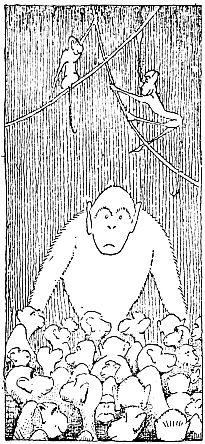 “Then the Grand Gorillagot up”
Then Chee-Chee gotup; and all the otherswhispered, “Sh! Look!Chee-Chee, the greatTraveler, is about tospeak!”
And Chee-Chee saidto the other monkeys,
“My friends, I amafraid it is useless to askthe Doctor to stay. Heowes money in Puddleby;and he says he mustgo back and pay it.”
And the monkeysasked him, “What ismoney?”
Then Chee-Chee toldthem that in the Landof the White Men you could get nothing withoutmoney; you could donothing without money—that[77]it was almost impossible to livewithoutmoney.
And some of them asked, “But can you noteven eat and drink without paying?”
But Chee-Chee shook his head. And then hetold them that even he, when he was with theorgan-grinder, had been made to ask the childrenfor money.
And the Chief Chimpanzee turned to theOldest Orang-outang and said, “Cousin, surelythese Men be strange creatures! Who wouldwish to live in such a land? My gracious, howpaltry!”
Then Chee-Chee said,
“When we were coming to you we had noboat to cross the sea in and no money to buyfood to eat on our journey. So a man lent ussome biscuits; and we said we would pay himwhen we came back. And we borrowed a boatfrom a sailor; but it was broken on the rockswhen we reached the shores of Africa. Nowthe Doctor says he must go back and get thesailor another boat—because the man was poorand his ship was all he had.”
[78]
And the monkeys were all silent for a while,sitting quite still upon the ground and thinkinghard.
At last the Biggest Baboon got up and said,
“I do not think we ought to let this good manleave our land till we have given him a finepresent to take with him, so that he may knowwe are grateful for all that he has done forus.”
And a little, tiny red monkey who was sittingup in a tree shouted down,
“I think that too!”
And then they all cried out, making a greatnoise, “Yes, yes. Let us give him the finestpresent a White Man ever had!”
Now they began to wonder and ask one anotherwhat would be the best thing to give him.And one said, “Fifty bags of cocoanuts!” Andanother—“A hundred bunches of bananas!—Atleast he shall not have to buy his fruit in theLand Where You Pay to Eat!”
But Chee-Chee told them that all thesethings would be too heavy to carry so far andwould go bad before half was eaten.
[79]
“If you want to please him,” he said, “givehim an animal. You may be sure he will bekind to it. Give him some rare animal theyhave not got in the menageries.”
And the monkeys asked him, “What aremenageries?”
Then Chee-Chee explained to them thatmenageries were places in the Land of theWhite Men, where animals were put in cagesfor people to come and look at. And themonkeys were very shocked and said to oneanother,
“These Men are like thoughtless young ones—stupidand easily amused. Sh! It is a prisonhe means.”
So then they asked Chee-Chee what rare animalit could be that they should give the Doctor—onethe White Men had not seen before.And the Major of the Marmosettes asked,
“Have they an iguana over there?”
But Chee-Chee said, “Yes, there is one in theLondon Zoo.”
And another asked, “Have they an okapi?”
But Chee-Chee said, “Yes. In Belgium[80],where my organ-grinder took me five years ago,they had an okapi in a big city they call Antwerp.”
And another asked, “Have they a pushmi-pullyu?”
Then Chee-Chee said, “No. No WhiteMan has ever seen a pushmi-pullyu. Let usgive him that.”
[81]
THE TENTH CHAPTER
THE RAREST ANIMAL OF ALL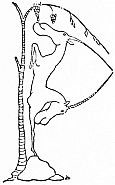
PUSHMI-PULLYUS are nowextinct. That means, therearen’t any more. But long ago,when Doctor Dolittle was alive,there were some of them still leftin the deepest jungles of Africa;and even then they were very, veryscarce. They had no tail, but a head at each end,and sharp horns on each head. They were veryshy and terribly hard to catch. The black menget most of their animals by sneaking up behindthem while they are not looking. But you couldnot do this with the pushmi-pullyu—because, nomatter which way you came towards him, hewas always facing you. And besides, only onehalf of him slept at a time. The other headwas always awake—and watching. This waswhy they were never caught and never seen in[82]Zoos. Though many of the greatest huntsmenand the cleverest menagerie-keepers spentyears of their lives searching through thejungles in all weathers for pushmi-pullyus, not asingle one had ever been caught. Even then,years ago, he was the only animal in the worldwith two heads.
Well, the monkeys set out hunting for thisanimal through the forest. And after they hadgone a good many miles, one of them foundpeculiar footprints near the edge of a river;and they knew that a pushmi-pullyu must bevery near that spot.
Then they went along the bank of the rivera little way and they saw a place where thegrass was high and thick; and they guessed thathe was in there.
So they all joined hands and made a greatcircle round the high grass. The pushmi-pullyuheard them coming; and he tried hardto break through the ring of monkeys. But hecouldn’t do it. When he saw that it was nouse trying to escape, he sat down and waited tosee what they wanted.
[83]
They asked him if he would go with DoctorDolittle and be put on show in the Land of theWhite Men.
But he shook both his heads hard and said,“Certainly not!”
They explained to him that he would not beshut up in a menagerie but would just be lookedat. They told him that the Doctor was a verykind man but hadn’t any money; and peoplewould pay to see a two-headed animal and theDoctor would get rich and could pay for the boathe had borrowed to come to Africa in.
But he answered, “No. You know how shyI am—I hate being stared at.” And he almostbegan to cry.
Then for three days they tried to persuadehim.
And at the end of the third day he said hewould come with them and see what kind of aman the Doctor was, first.
So the monkeys traveled back with thepushmi-pullyu. And when they came to wherethe Doctor’s little house of grass was, theyknocked on the door.
[84]
The duck, who was packing the trunk, said,“Come in!”
And Chee-Chee very proudly took the animalinside and showed him to the Doctor.
“What in the world is it?” asked John Dolittle,gazing at the strange creature.
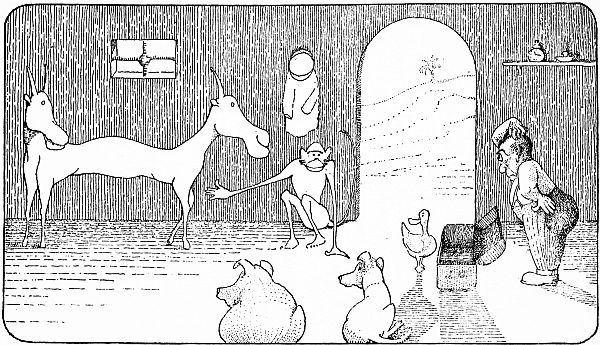
“Lord save us!” cried the duck. “How doesit make up its mind?”
“It doesn’t look to me as though it had any,”said Jip, the dog.
“This, Doctor,” said Chee-Chee, “is thepushmi-pullyu—the rarest animal of the Africanjungles, the only two-headed beast in theworld! Take him home with you and yourfortune’s made. People will pay any money tosee him.”
“But I don’t want any money,” said the Doctor.
“Yes, you do,” said Dab-Dab, the duck.“Don’t you remember how we had to pinchand scrape to pay the butcher’s bill in Puddleby?And how are you going to get thesailor the new boat you spoke of—unless we havethe money to buy it?”
[85]
 “‘Lord save us!’ cried the duck. ‘How does it make up its mind?’”
[86]
“I was going to make him one,” said the Doctor.
“Oh, do be sensible!” cried Dab-Dab.“Where would you get all the wood and thenails to make one with?—And besides, what arewe going to live on? We shall be poorer thanever when we get back. Chee-Chee’s perfectlyright: take the funny-looking thing along, do!”
“Well, perhaps there is something in whatyou say,” murmured the Doctor. “It certainlywould make a nice new kind of pet. But doesthe er—what-do-you-call-it really want to goabroad?”
“Yes, I’ll go,” said the pushmi-pullyu whosaw at once, from the Doctor’s face, that he wasa man to be trusted. “You have been so kindto the animals here—and the monkeys tell methat I am the only one who will do. But youmust promise me that if I do not like it in theLand of the White Men you will send meback.”
“Why, certainly—of course, of course,” saidthe Doctor. “Excuse me, surely you are relatedto the Deer Family, are you not?”
[87]
“Yes,” said the pushmi-pullyu—“to theAbyssinian Gazelles and the Asiatic Chamois—onmy mother’s side. My father’s great-grandfatherwas the last of the Unicorns.”
“Most interesting!” murmured the Doctor;and he took a book out of the trunk which Dab-Dabwas packing and began turning the pages.“Let us see if Buffon says anything—”
“I notice,” said the duck, “that you only talkwith one of your mouths. Can’t the other headtalk as well?”
“Oh, yes,” said the pushmi-pullyu. “But Ikeep the other mouth for eating—mostly. Inthat way I can talk while I am eating withoutbeing rude. Our people have always been verypolite.”
When the packing was finished and everythingwas ready to start, the monkeys gave agrand party for the Doctor, and all the animalsof the jungle came. And they had pineapplesand mangoes and honey and all sorts of goodthings to eat and drink.
After they had all finished eating, the Doctorgot up and said,
[88]
“My friends: I am not clever at speakinglong words after dinner, like some men; and Ihave just eaten many fruits and much honey.But I wish to tell you that I am very sad atleaving your beautiful country. Because I havethings to do in the Land of the White Men, Imust go. After I have gone, remember neverto let the flies settle on your food before youeat it; and do not sleep on the ground when therains are coming. I—er—er—I hope you willall live happily ever after.”
When the Doctor stopped speaking and satdown, all the monkeys clapped their hands along time and said to one another, “Let it beremembered always among our people that hesat and ate with us, here, under the trees. Forsurely he is the Greatest of Men!”
And the Grand Gorilla, who had the strengthof seven horses in his hairy arms, rolled a greatrock up to the head of the table and said,
“This stone for all time shall mark the spot.”
And even to this day, in the heart of the jungle,that stone still is there. And monkey-mothers,passing through the forest with their[89]families, still point down at it from the branchesand whisper to their children, “Sh! There itis—look—where the Good White Man sat andate food with us in the Year of the Great Sickness!”
Then, when the party was over, the Doctorand his pets started out to go back to the seashore.And all the monkeys went with him asfar as the edge of their country, carrying histrunk and bags, to see him off.
[90]
[91]THE ELEVENTH CHAPTER
THE BLACK PRINCE
BY the edge of the river theystopped and said farewell.
This took a long time, becauseall those thousands of monkeyswanted to shake John Dolittle bythe hand.
Afterwards, when the Doctor and his petswere going on alone, Polynesia said,
“We must tread softly and talk low as wego through the land of the Jolliginki. If theKing should hear us, he will send his soldiersto catch us again; for I am sure he is still veryangry over the trick I played on him.”
“What I am wondering,” said the Doctor,“is where we are going to get another boat togo home in.... Oh well, perhaps we’ll findone lying about on the beach that nobody isusing. ‘Never lift your foot till you come tothe stile.’”
[92]
One day, while they were passing througha very thick part of the forest, Chee-Chee wentahead of them to look for cocoanuts. Andwhile he was away, the Doctor and the rest ofthe animals, who did not know the jungle-pathsso well, got lost in the deep woods. They wanderedaround and around but could not findtheir way down to the seashore.
Chee-Chee, when he could not see them anywhere,was terribly upset. He climbed hightrees and looked out from the top branches totry and see the Doctor’s high hat; he waved andshouted; he called to all the animals by name.But it was no use. They seemed to have disappearedaltogether.
Indeed they had lost their way very badly.They had strayed a long way off the path, andthe jungle was so thick with bushes and creepersand vines that sometimes they could hardlymove at all, and the Doctor had to take outhis pocket-knife and cut his way along. Theystumbled into wet, boggy places; they got alltangled up in thick convolvulus-runners; theyscratched themselves on thorns, and twice they[93]nearly lost the medicine-bag in the under-brush.There seemed no end to their troubles; andnowhere could they come upon a path.
At last, after blundering about like this formany days, getting their clothes torn and theirfaces covered with mud, they walked right intothe King’s back-garden by mistake. The King’smen came running up at once and caught them.
But Polynesia flew into a tree in the garden,without anybody seeing her, and hid herself.The Doctor and the rest were taken before theKing.
“Ha, ha!” cried the King. “So you arecaught again! This time you shall not escape.Take them all back to prison and put doublelocks on the door. This White Man shallscrub my kitchen-floor for the rest of hislife!”
So the Doctor and his pets were led back toprison and locked up. And the Doctor was toldthat in the morning he must begin scrubbing thekitchen-floor.
They were all very unhappy.
“This is a great nuisance,” said the Doctor.[94]“I really must get back to Puddleby. Thatpoor sailor will think I’ve stolen his ship if Idon’t get home soon.... I wonder if thosehinges are loose.”
But the door was very strong and firmlylocked. There seemed no chance of getting out.Then Gub-Gub began to cry again.
All this time Polynesia was still sitting in thetree in the palace-garden. She was saying nothingand blinking her eyes.
This was always a very bad sign with Polynesia.Whenever she said nothing and blinkedher eyes, it meant that somebody had been makingtrouble, and she was thinking out some wayto put things right. People who made troublefor Polynesia or her friends were nearly alwayssorry for it afterwards.
Presently she spied Chee-Chee swingingthrough the trees still looking for the Doctor.When Chee-Chee saw her, he came into hertree and asked her what had become of him.
“The Doctor and all the animals have beencaught by the King’s men and locked up again,”[95]whispered Polynesia. “We lost our way in thejungle and blundered into the palace-garden bymistake.”
“But couldn’t you guide them?” asked Chee-Chee;and he began to scold the parrot for lettingthem get lost while he was away lookingfor the cocoanuts.
“It was all that stupid pig’s fault,” saidPolynesia. “He would keep running off thepath hunting for ginger-roots. And I was keptso busy catching him and bringing him back,that I turned to the left, instead of the right,when we reached the swamp.—Sh!—Look!There’s Prince Bumpo coming into the garden!He must not see us.—Don’t move, whatever youdo!”
And there, sure enough, was Prince Bumpo,the King’s son, opening the garden-gate. Hecarried a book of fairy-tales under his arm. Hecame strolling down the gravel-walk, humminga sad song, till he reached a stone seat right underthe tree where the parrot and the monkeywere hiding. Then he lay down on the seat[96]and began reading the fairy-stories to himself.
Chee-Chee and Polynesia watched him,keeping very quiet and still.
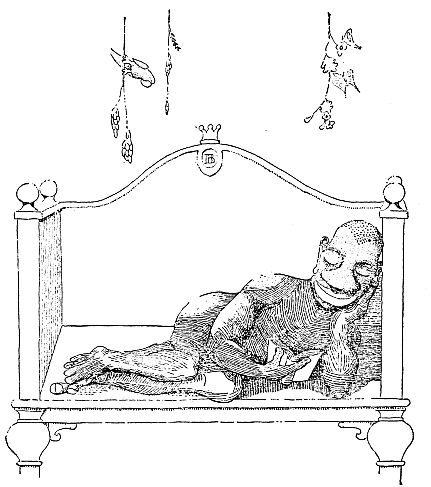 “He began reading the fairy-stories to himself”
After a while the King’s son laid the bookdown and sighed a weary sigh.
[97]
“If I were only a whiteprince!” said he, witha dreamy, far-away look in his eyes.
Then the parrot, talking in a small, high voicelike a little girl, said aloud,
“Bumpo, some one might turn thee into awhite prince perchance.”
The King’s son started up off the seat andlooked all around.
“What is this I hear?” he cried. “Methoughtthe sweet music of a fairy’s silver voice rangfrom yonder bower! Strange!”
“Worthy Prince,” said Polynesia, keepingvery still so Bumpo couldn’t see her, “thou sayestwinged words of truth. For ’tis I, Tripsitinka,the Queen of the Fairies, that speak tothee. I am hiding in a rose-bud.”
“Oh tell me, Fairy-Queen,” cried Bumpo,clasping his hands in joy, “who is it can turnme white?”
“In thy father’s prison,” said the parrot, “therelies a famous wizard, John Dolittle by name.Many things he knows of medicine and magic,and mighty deeds has he performed. Yet thykingly father leaves him languishing long and[98]lingering hours. Go to him, brave Bumpo,secretly, when the sun has set; and behold, thoushalt be made the whitest prince that ever wonfair lady! I have said enough. I must now goback to Fairyland. Farewell!”
“Farewell!” cried the Prince. “A thousandthanks, good Tripsitinka!”
And he sat down on the seat again with a smileupon his face, waiting for the sun to set.
[99]
THE TWELFTH CHAPTER
MEDICINE AND MAGIC
VERY, very quietly, makingsure that no one should seeher, Polynesia then slippedout at the back of the treeand flew across to theprison.
She found Gub-Gub poking his nose throughthe bars of the window, trying to sniff thecooking-smells that came from the palace-kitchen.She told the pig to bring the Doctorto the window because she wanted to speak tohim. So Gub-Gub went and woke the Doctorwho was taking a nap.
“Listen,” whispered the parrot, when JohnDolittle’s face appeared: “Prince Bumpo iscoming here to-night to see you. And you’vegot to find some way to turn him white. Butbe sure to make him promise you first that he[100]will open the prison-door and find a ship foryou to cross the sea in.”
“This is all very well,” said the Doctor.“But it isn’t so easy to turn a black man white.You speak as though he were a dress to be re-dyed.It’s not so simple. ‘Shall the leopardchange his spots, or the Ethiopian his skin,’ youknow?”
“I don’t know anything about that,” saidPolynesia impatiently. “But you mustturn thiscoon white. Think of a way—think hard.You’ve got plenty of medicines left in the bag.He’ll do anything for you if you change hiscolor. It is your only chance to get out ofprison.”
“Well, I suppose it mightbe possible,” saidthe Doctor. “Let me see—,” and he went overto his medicine-bag, murmuring somethingabout “liberated chlorine on animal-pigment—perhapszinc-ointment, as a temporary measure,spread thick—”
Well, that night Prince Bumpo came secretlyto the Doctor in prison and said to him,
“White Man, I am an unhappy prince.[101]Years ago I went in search of The SleepingBeauty, whom I had read of in a book. Andhaving traveled through the world many days,I at last found her and kissed the lady verygently to awaken her—as the book said I should.’Tis true indeed that she awoke. But whenshe saw my face she cried out, ‘Oh, he’s black!’And she ran away and wouldn’t marry me—butwent to sleep again somewhere else. So I cameback, full of sadness, to my father’s kingdom.Now I hear that you are a wonderful magicianand have many powerful potions. So I come toyou for help. If you will turn me white, sothat I may go back to The Sleeping Beauty, Iwill give you half my kingdom and anything besidesyou ask.”
“Prince Bumpo,” said the Doctor, lookingthoughtfully at the bottles in his medicine-bag,“supposing I made your hair a nice blondecolor—would not that do instead to make youhappy?”
“No,” said Bumpo. “Nothing else will satisfyme. I must be a white prince.”
“You know it is very hard to change the color[102]of a prince,” said the Doctor—“one of the hardestthings a magician can do. You only wantyour face white, do you not?”
“Yes, that is all,” said Bumpo. “Because Ishall wear shining armor and gauntlets of steel,like the other white princes, and ride on ahorse.”
“Must your face be white all over?” askedthe Doctor.
“Yes, all over,” said Bumpo—“and I wouldlike my eyes blue too, but I suppose that wouldbe very hard to do.”
“Yes, it would,” said the Doctor quickly.“Well, I will do what I can for you. You willhave to be very patient though—you know withsome medicines you can never be very sure. Imight have to try two or three times. You havea strong skin—yes? Well that’s all right.Now come over here by the light—Oh, but beforeI do anything, you must first go down tothe beach and get a ship ready, with food in it,to take me across the sea. Do not speak a wordof this to any one. And when I have done asyou ask, you must let me and all my animals[103]out of prison. Promise—by the crown of Jolliginki!”
So the Prince promised and went away to geta ship ready at the seashore.
When he came back and said that it was done,the Doctor asked Dab-Dab to bring a basin.Then he mixed a lot of medicines in the basinand told Bumpo to dip his face in it.
The Prince leaned down and put his face in—rightup to the ears.
He held it there a long time—so long thatthe Doctor seemed to get dreadfully anxiousand fidgety, standing first on one leg and thenon the other, looking at all the bottles he hadused for the mixture, and reading the labels onthem again and again. A strong smell filledthe prison, like the smell of brown paper burning.
At last the Prince lifted his face up out of thebasin, breathing very hard. And all the animalscried out in surprise.
For the Prince’s face had turned as white assnow, and his eyes, which had been mud-colored,were a manly gray!
[104]
When John Dolittle lent him a little looking-glassto see himself in, he sang for joy and begandancing around the prison. But the Doctorasked him not to make so much noise aboutit; and when he had closed his medicine-bagin a hurry he told him to open the prison-door.
Bumpo begged that he might keep the looking-glass,as it was the only one in the Kingdomof Jolliginki, and he wanted to look at himselfall day long. But the Doctor said he neededit to shave with.
Then the Prince, taking a bunch of copperkeys from his pocket, undid the great doublelocks. And the Doctor with all his animals ranas fast as they could down to the seashore; whileBumpo leaned against the wall of the emptydungeon, smiling after them happily, his bigface shining like polished ivory in the light ofthe moon.
When they came to the beach they saw Polynesiaand Chee-Chee waiting for them on therocks near the ship.
“I feel sorry about Bumpo,” said the Doctor.[105]“I am afraid that medicine I used will neverlast. Most likely he will be as black as everwhen he wakes up in the morning—that’s onereason why I didn’t like to leave the mirror withhim. But then again, he mightstay white—Ihad never used that mixture before. To tell thetruth, I was surprised, myself, that it workedso well. But I had to do something, didn’t I?—Icouldn’t possibly scrub the King’s kitchenfor the rest of my life. It was such a dirtykitchen!—I could see it from the prison-window.—Well,well!—Poor Bumpo!”
“Oh, of course he will know we were justjoking with him,” said the parrot.
“They had no business to lock us up,” saidDab-Dab, waggling her tail angrily. “Wenever did them any harm. Serve him right, ifhe does turn black again! I hope it’s a darkblack.”
“But hedidn’t have anything to do with it,”said the Doctor. “It was the King, his father,who had us locked up—it wasn’t Bumpo’s fault....I wonder if I ought to go back and apologize—Oh,well—I’ll send him some candy[106]when I get to Puddleby. And who knows?—hemay stay white after all.”
“The Sleeping Beauty would never have him,even if he did,” said Dab-Dab. “He looked betterthe way he was, I thought. But he’d neverbe anything but ugly, no matter what color hewas made.”
“Still, he had a good heart,” said the Doctor—“romantic,of course—but a good heart. Afterall, ‘handsome is as handsome does.’”
“I don’t believe the poor booby found TheSleeping Beauty at all,” said Jip, the dog.“Most likely he kissed some farmer’s fat wifewho was taking a snooze under an apple-tree.Can’t blame her for getting scared! I wonderwho he’ll go and kiss this time. Silly business!”
Then the pushmi-pullyu, the white mouse,Gub-Gub, Dab-Dab, Jip and the owl, Too-Too,went on to the ship with the Doctor. But Chee-Chee,Polynesia and the crocodile stayed behind,because Africa was their proper home, the landwhere they were born.
And when the Doctor stood upon the boat, he[107]looked over the side across the water. And thenhe remembered that they had no one with themto guide them back to Puddleby.
The wide, wide sea looked terribly big andlonesome in the moonlight; and he began towonder if they would lose their way when theypassed out of sight of land.
But even while he was wondering, they hearda strange whispering noise, high in the air,coming through the night. And the animals allstopped saying Good-by and listened.
The noise grew louder and bigger. It seemedto be coming nearer to them—a sound like theAutumn wind blowing through the leaves of apoplar-tree, or a great, great rain beating downupon a roof.
And Jip, with his nose pointing and his tailquite straight, said,
“Birds!—millions of them—flying fast—that’sit!”
And then they all looked up. And there,streaming across the face of the moon, like ahuge swarm of tiny ants, they could see thousandsand thousands of little birds. Soon the[108]whole sky seemed full of them, and still morekept coming—more and more. There were somany that for a little they covered the wholemoon so it could not shine, and the sea grewdark and black—like when a storm-cloud passesover the sun.
And presently all these birds came down close,skimming over the water and the land; and thenight-sky was left clear above, and the moonshone as before. Still never a call nor a crynor a song they made—no sound but this greatrustling of feathers which grew greater nowthan ever. When they began to settle on thesands, along the ropes of the ship—anywhereand everywhere except the trees—the Doctorcould see that they had blue wings and whitebreasts and very short, feathered legs. As soonas they had all found a place to sit, suddenly,there was no noise left anywhere—all was quiet;all was still.
And in the silent moonlight John Dolittlespoke:
“I had no idea that we had been in Africaso long. It will be nearly Summer when we[109]get home. For these are the swallows goingback. Swallows, I thank you for waiting forus. It is very thoughtful of you. Now we neednot be afraid that we will lose our way upon thesea.... Pull up the anchor and set the sail!”
 “Crying bitterly and waving till the ship was out of sight”
When the ship moved out upon the water,those who stayed behind, Chee-Chee, Polynesiaand the crocodile, grew terribly sad. For neverin their lives had they known any one they likedso well as Doctor John Dolittle of Puddleby-on-the-Marsh.
[110]
And after they had called Good-by to himagain and again and again, they still stood thereupon the rocks, crying bitterly and waving tillthe ship was out of sight.
[111]
THE THIRTEENTH CHAPTER
RED SAILS AND BLUE WINGS
SAILING homeward, the Doctor’sship had to pass the coastof Barbary. This coast is theseashore of the Great Desert. Itis a wild, lonely place—all sandand stones. And it was here thatthe Barbary pirates lived.
These pirates, a bad lot of men, used to waitfor sailors to be shipwrecked on their shores.And often, if they saw a boat passing, they wouldcome out in their fast sailing-ships and chase it.When they caught a boat like this at sea, theywould steal everything on it; and after they hadtaken the people off they would sink the shipand sail back to Barbary singing songs and feelingproud of the mischief they had done. Thenthey used to make the people they had caughtwrite home to their friends for money. And if[112]the friends sent no money, the pirates often threwthe people into the sea.
Now one sunshiny day the Doctor and Dab-Dabwere walking up and down on the shipfor exercise; a nice fresh wind was blowing theboat along, and everybody was happy. PresentlyDab-Dab saw the sail of another ship along way behind them on the edge of the sea.It was a red sail.
“I don’t like the look of that sail,” said Dab-Dab.“I have a feeling it isn’t a friendly ship.I am afraid there is more trouble coming tous.”
Jip, who was lying near taking a nap in thesun, began to growl and talk in his sleep.
“I smell roast beef cooking,” he mumbled—“underdoneroast beef—with brown gravy overit.”
“Good gracious!” cried the Doctor. “What’sthe matter with the dog? Is he smellingin hissleep—as well as talking?”
“I suppose he is,” said Dab-Dab. “All dogscan smell in their sleep.”
“But what is he smelling?” asked the Doctor.[113]“There is no roast beef cooking on our ship.”
“No,” said Dab-Dab. “The roast beef mustbe on that other ship over there.”
“But that’s ten miles away,” said the Doctor.“He couldn’t smell that far surely!”
“Oh, yes, he could,” said Dab-Dab. “Youask him.”
Then Jip, still fast asleep, began to growlagain and his lip curled up angrily, showinghis clean, white teeth.
“I smell bad men,” he growled—“the worstmen I ever smelt. I smell trouble. I smell afight—six bad scoundrels fighting against onebrave man. I want to help him. Woof—oo—WOOF!”Then he barked, loud, and wokehimself up with a surprised look on his face.
“See!” cried Dab-Dab. “That boat is nearernow. You can count its three big sails—all red.Whoever it is, they are coming after us.... Iwonder who they are.”
“They are bad sailors,” said Jip; “and theirship is very swift. They are surely the piratesof Barbary.”
“Well, we must put up more sails on our boat,”[114]said the Doctor, “so we can go faster and getaway from them. Run downstairs, Jip, andfetch me all the sails you see.”
The dog hurried downstairs and dragged upevery sail he could find.
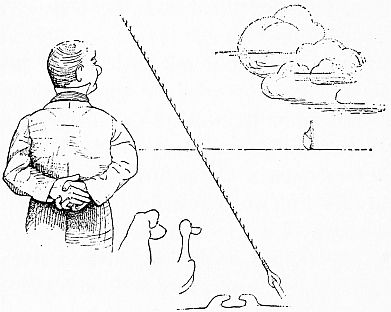 “‘They are surely the pirates of Barbary’”
But even when all these were put up on themasts to catch the wind, the boat did not gonearly as fast as the pirates’—which kept comingon behind, closer and closer.
“This is a poor ship the Prince gave us,” saidGub-Gub, the pig—“the slowest he could find, I[115]should think. Might as well try to win a racein a soup-tureen as hope to get away from themin this old barge. Look how near they are now!—Youcan see the mustaches on the faces of themen—six of them. What are we going to do?”
Then the Doctor asked Dab-Dab to fly up andtell the swallows that pirates were coming afterthem in a swift ship, and what should he doabout it.
When the swallows heard this, they all camedown on to the Doctor’s ship; and they told himto unravel some pieces of long rope and makethem into a lot of thin strings as quickly as hecould. Then the ends of these strings were tiedon to the front of the ship; and the swallowstook hold of the strings with their feet and flewoff, pulling the boat along.
And although swallows are not very strongwhen only one or two are by themselves, it isdifferent when there are a great lot of them together.And there, tied to the Doctor’s ship,were a thousand strings; and two thousand swallowswere pulling on each string—all terriblyswift fliers.
[116]
And in a moment the Doctor found himselftraveling so fast he had to hold his hat on withboth hands; for he felt as though the ship itselfwere flying through waves that frothed andboiled with speed.
And all the animals on the ship began tolaugh and dance about in the rushing air, forwhen they looked back at the pirates’ ship, theycould see that it was growing smaller now, insteadof bigger. The red sails were being leftfar, far behind.
[117]
THE FOURTEENTH CHAPTER
THE RATS’ WARNING
DRAGGING a ship through thesea is hard work. And aftertwo or three hours the swallowsbegan to get tired in thewings and short of breath.Then they sent a messagedown to the Doctor to say that they would haveto take a rest soon; and that they would pull theboat over to an island not far off, and hide it ina deep bay till they had got breath enough togo on.
And presently the Doctor saw the island theyhad spoken of. It had a very beautiful, high,green mountain in the middle of it.
When the ship had sailed safely into the baywhere it could not be seen from the open sea,the Doctor said he would get off on to the islandto look for water—because there was none left[118]to drink on his ship. And he told all the animalsto get out too and romp on the grass tostretch their legs.
Now as they were getting off, the Doctor noticedthat a whole lot of rats were coming upfrom downstairs and leaving the ship as well.Jip started to run after them, because chasingrats had always been his favorite game. Butthe Doctor told him to stop.
And one big black rat, who seemed to wantto say something to the Doctor, now crept forwardtimidly along the rail, watching the dogout of the corner of his eye. And after he hadcoughed nervously two or three times, andcleaned his whiskers and wiped his mouth, hesaid,
“Ahem—er—you know of course that all shipshave rats in them, Doctor, do you not?”
And the Doctor said, “Yes.”
“And you have heard that rats always leavea sinking ship?”
“Yes,” said the Doctor—“so I’ve been told.”
“People,” said the rat, “always speak of itwith a sneer—as though it were something disgraceful.[119]But you can’t blame us, can you?After all, who wouldstay on a sinking ship, ifhe could get off it?”
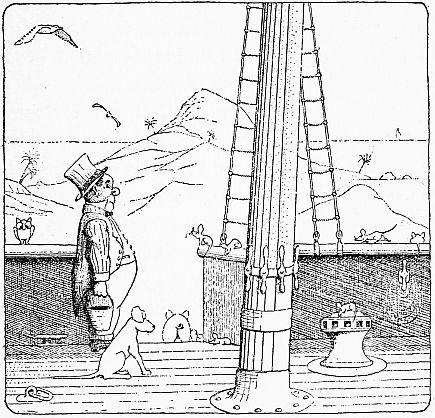 “‘And you have heard that rats always leave a sinkingship?’”
“It’s very natural,” said the Doctor—“verynatural. I quite understand.... Was there—Wasthere anything else you wished to say?”
[120]
“Yes,” said the rat. “I’ve come to tell youthat we are leaving this one. But we wanted towarn you before we go. This is a bad ship youhave here. It isn’t safe. The sides aren’tstrong enough. Its boards are rotten. Beforeto-morrow night it will sink to the bottom of thesea.”
“But how do you know?” asked the Doctor.
“We always know,” answered the rat. “Thetips of our tails get that tingly feeling—likewhen your foot’s asleep. This morning, at sixo’clock, while I was getting breakfast, my tailsuddenly began to tingle. At first I thoughtit was my rheumatism coming back. So I wentand asked my aunt how she felt—you rememberher?—the long, piebald rat, rather skinny, whocame to see you in Puddleby last Spring withjaundice? Well—and she said hertail wastingling like everything! Then we knew, forsure, that this boat was going to sink in less thantwo days; and we all made up our minds toleave it as soon as we got near enough to anyland. It’s a bad ship, Doctor. Don’t sail init any more, or you’ll be surely drowned....[121]Good-by! We are now going to look for a goodplace to live on this island.”
“Good-by!” said the Doctor. “And thankyou very much for coming to tell me. Veryconsiderate of you—very! Give my regards toyour aunt. I remember her perfectly....Leave that rat alone, Jip! Come here! Liedown!”
So then the Doctor and all his animals wentoff, carrying pails and saucepans, to look forwater on the island, while the swallows tooktheir rest.
“I wonder what is the name of this island,”said the Doctor, as he was climbing up themountainside. “It seems a pleasant place.What a lot of birds there are!”
“Why, these are the Canary Islands,” saidDab-Dab. “Don’t you hear the canaries singing?”
The Doctor stopped and listened.
“Why, to be sure—of course!” he said.“How stupid of me! I wonder if they can tellus where to find water.”
And presently the canaries, who had heard all[122]about Doctor Dolittle from birds of passage,came and led him to a beautiful spring of cool,clear water where the canaries used to take theirbath; and they showed him lovely meadowswhere the bird-seed grew and all the othersights of their island.
And the pushmi-pullyu was glad they hadcome; because he liked the green grass so muchbetter than the dried apples he had been eatingon the ship. And Gub-Gub squeaked for joywhen he found a whole valley full of wild sugar-cane.
A little later, when they had all had plentyto eat and drink, and were lying on their backswhile the canaries sang for them, two of theswallows came hurrying up, very flustered andexcited.
“Doctor!” they cried, “the pirates have comeinto the bay; and they’ve all got on to your ship.They are downstairs looking for things to steal.They have left their own ship with nobody onit. If you hurry and come down to the shore,you can get on to their ship—which is very fast—andescape. But you’ll have to hurry.”
[123]
“That’s a good idea,” said the Doctor—“splendid!”
And he called his animals together at once,said Good-by to the canaries and ran down to thebeach.
When they reached the shore they saw thepirate-ship, with the three red sails, standing inthe water; and—just as the swallows had said—therewas nobody on it; all the pirates weredownstairs in the Doctor’s ship, looking forthings to steal.
So John Dolittle told his animals to walk verysoftly and they all crept on to the pirate-ship.
[124]
[125]THE FIFTEENTH CHAPTER
THE BARBARY DRAGON
EVERYTHING would have goneall right if the pig had not caughta cold in his head while eatingthe damp sugar-cane on theisland. This is what happened:
After they had pulled up theanchor without a sound, and were moving theship very, very carefully out of the bay, Gub-Gubsuddenly sneezed so loud that the pirateson the other ship came rushing upstairs to seewhat the noise was.
As soon as they saw that the Doctor was escaping,they sailed the other boat right acrossthe entrance to the bay so that the Doctor couldnot get out into the open sea.
Then the leader of these bad men (who calledhimself “Ben Ali, The Dragon”) shook his fistat the Doctor and shouted across the water,
[126]
“Ha! Ha! You are caught, my fine friend!You were going to run off in my ship, eh? Butyou are not a good enough sailor to beat BenAli, the Barbary Dragon. I want that duckyou’ve got—and the pig too. We’ll have pork-chopsand roast duck for supper to-night. Andbefore I let you go home, you must make yourfriends send me a trunk-full of gold.”
Poor Gub-Gub began to weep; and Dab-Dabmade ready to fly to save her life. But the owl,Too-Too, whispered to the Doctor,
“Keep him talking, Doctor. Be pleasant tohim. Our old ship is bound to sink soon—therats said it would be at the bottom of the sea beforeto-morrow-night—and the rats are neverwrong. Be pleasant, till the ship sinks underhim. Keep him talking.”
“What, until to-morrow night!” said the Doctor.“Well, I’ll do my best.... Let me see—Whatshall I talk about?”
“Oh, let them come on,” said Jip. “We canfight the dirty rascals. There are only six ofthem. Let them come on. I’d love to tell thatcollie next door, when we get home, that I had[127]bitten a real pirate. Let ’em come. We canfight them.”
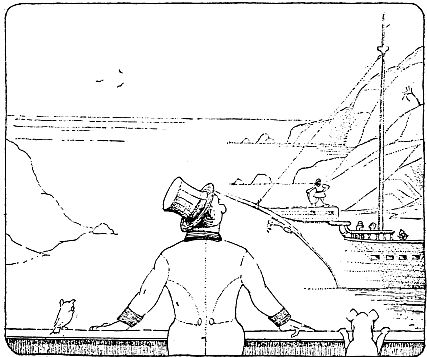 “‘Look here, Ben Ali—’”
“But they have pistols and swords,” said theDoctor. “No, that would never do. I musttalk to him.... Look here, Ben Ali—”
But before the Doctor could say any more,the pirates began to sail the ship nearer, laughingwith glee, and saying one to another, “Whoshall be the first to catch the pig?”
[128]
Poor Gub-Gub was dreadfully frightened;and the pushmi-pullyu began to sharpen hishorns for a fight by rubbing them on the mastof the ship; while Jip kept springing into theair and barking and calling Ben Ali bad namesin dog-language.
But presently something seemed to go wrongwith the pirates; they stopped laughing andcracking jokes; they looked puzzled; somethingwas making them uneasy.
Then Ben Ali, staring down at his feet, suddenlybellowed out,
“Thunder and Lightning!—Men, the boat’sleaking!”
And then the other pirates peered over theside and they saw that the boat was indeed gettinglower and lower in the water. And oneof them said to Ben Ali,
“But surely if this old boat were sinking weshould see the rats leaving it.”
And Jip shouted across from the other ship,
“You great duffers, there are no rats thereto leave! They left two hours ago! ‘Ha, ha,’to you, ‘my fine friends!’”
[129]
But of course the men did not understand him.
Soon the front end of the ship began to godown and down, faster and faster—till the boatlooked almost as though it were standing on itshead; and the pirates had to cling to the railsand the masts and the ropes and anything tokeep from sliding off. Then the sea rushedroaring in through all the windows and thedoors. And at last the ship plunged right downto the bottom of the sea, making a dreadfulgurgling sound; and the six bad men were leftbobbing about in the deep water of the bay.
Some of them started to swim for the shoresof the island; while others came and tried to geton to the boat where the Doctor was. But Jipkept snapping at their noses, so they were afraidto climb up the side of the ship.
Then suddenly they all cried out in great fear,
“The sharks!The sharks are coming! Letus get on to the ship before they eat us! Help,help!—The sharks! The sharks!”
And now the Doctor could see, all over thebay, the backs of big fishes swimming swiftlythrough the water.
[130]
And one great shark came near to the ship,and poking his nose out of the water he said tothe Doctor,
“Are you John Dolittle, the famous animal-doctor?”
“Yes,” said Doctor Dolittle. “That is myname.”
“Well,” said the shark, “we know these piratesto be a bad lot—especially Ben Ali. If theyare annoying you, we will gladly eat them up foryou—and then you won’t be troubled anymore.”
“Thank you,” said the Doctor. “This isreally most attentive. But I don’t think it willbe necessary to eat them. Don’t let any of themreach the shore until I tell you—just keep themswimming about, will you? And please makeBen Ali swim over here that I may talk tohim.”
So the shark went off and chased Ben Ali overto the Doctor.
“Listen, Ben Ali,” said John Dolittle, leaningover the side. “You have been a very badman; and I understand that you have killed[131]many people. These good sharks here have justoffered to eat you up for me—and ’twould indeedbe a good thing if the seas were rid of you.But if you will promise to do as I tell you, Iwill let you go in safety.”
“What must I do?” asked the pirate, lookingdown sideways at the big shark who was smellinghis leg under the water.
“You must kill no more people,” said theDoctor; “you must stop stealing; you must neversink another ship; you must give up being apirate altogether.”
“But what shall I do then?” asked Ben Ali.“How shall I live?”
“You and all your men must go on to thisisland and be bird-seed-farmers,” the Doctor answered.“You must grow bird-seed for thecanaries.”
The Barbary Dragon turned pale with anger,“Grow bird-seed!” he groaned in disgust.“Can’t I be a sailor?”
“No,” said the Doctor, “you cannot. Youhave been a sailor long enough—and sent manystout ships and good men to the bottom of the[132]sea. For the rest of your life you must be apeaceful farmer. The shark is waiting. Donot waste any more of his time. Make up yourmind.”
“Thunder and Lightning!” Ben Ali muttered—“Bird-seed!”Then he looked down into thewater again and saw the great fish smelling hisother leg.
“Very well,” he said sadly. “We’ll be farmers.”
“And remember,” said the Doctor, “that ifyou do not keep your promise—if you startkilling and stealing again, I shall hear of it,because the canaries will come and tell me.And be very sure that I will find a way to punishyou. For though I may not be able to saila ship as well as you, so long as the birds andthe beasts and the fishes are my friends, I do nothave to be afraid of a pirate chief—even thoughhe call himself ‘The Dragon of Barbary.’ Nowgo and be a good farmer and live in peace.”
Then the Doctor turned to the big shark, andwaving his hand he said,
“All right. Let them swim safely to the land.”
[133]
THE SIXTEENTH CHAPTER
TOO-TOO, THE LISTENER
HAVING thanked the sharksagain for their kindness, theDoctor and his pets set offonce more on their journeyhome in the swift ship withthe three red sails.
As they moved out into the open sea, the animalsall went downstairs to see what their newboat was like inside; while the Doctor leant onthe rail at the back of the ship with a pipe in hismouth, watching the Canary Islands fade awayin the blue dusk of the evening.
While he was standing there, wondering howthe monkeys were getting on—and what hisgarden would look like when he got back toPuddleby, Dab-Dab came tumbling up thestairs, all smiles and full of news.
“Doctor!” she cried. “This ship of the pirates[134]is simply beautiful—absolutely. The bedsdownstairs are made of primrose silk—withhundreds of big pillows and cushions; there arethick, soft carpets on the floors; the dishes aremade of silver; and there are all sorts of goodthings to eat and drink—special things; thelarder—well, it’s just like a shop, that’s all.You never saw anything like it in your life—Justthink—they kept five different kinds ofsardines, those men! Come and look.... Oh,and we found a little room down there with thedoor locked; and we are all crazy to get in andsee what’s inside. Jip says it must be where thepirates kept their treasure. But we can’t openthe door. Come down and see if you can letus in.”
So the Doctor went downstairs and he saw thatit was indeed a beautiful ship. He found theanimals gathered round a little door, all talkingat once, trying to guess what was inside. TheDoctor turned the handle but it wouldn’t open.Then they all started to hunt for the key. Theylooked under the mat; they looked under all thecarpets; they looked in all the cupboards and[135]drawers and lockers—in the big chests in theship’s dining-room; they looked everywhere.
While they were doing this they discovereda lot of new and wonderful things that the piratesmust have stolen from other ships: Kashmirshawls as thin as a cobweb, embroideredwith flowers of gold; jars of fine tobacco fromJamaica; carved ivory boxes full of Russiantea; an old violin with a string broken and apicture on the back; a set of big chess-men,carved out of coral and amber; a walking-stickwhich had a sword inside it when you pulledthe handle; six wine-glasses with tourquoise andsilver round the rims; and a lovely great sugar-bowl,made of mother o’ pearl. But nowherein the whole boat could they find a key to fitthat lock.
So they all came back to the door, and Jippeered through the key-hole. But somethinghad been stood against the wall on the insideand he could see nothing.
While they were standing around, wonderingwhat they should do, the owl, Too-Too, suddenlysaid,
[136]
“Sh!—Listen!—I do believe there’s some onein there!”
They all kept still a moment. Then the Doctorsaid,
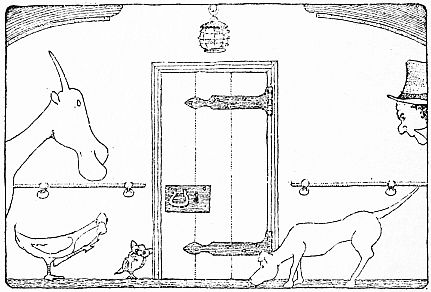 “‘Sh!—Listen!—I do believe there’s some one in there!’”
“You must be mistaken, Too-Too. I don’thear anything.”
“I’m sure of it,” said the owl. “Sh!—Thereit is again—Don’t you hear that?”
“No, I do not,” said the Doctor. “Whatkind of a sound is it?”
[137]
“I hear the noise of some one putting his handin his pocket,” said the owl.
“But that makes hardly any sound at all,” saidthe Doctor. “You couldn’t hear that out here.”
“Pardon me, but I can,” said Too-Too. “Itell you there is some one on the other side ofthat door putting his hand in his pocket. Almosteverything makes somenoise—if your earsare only sharp enough to catch it. Bats can heara mole walking in his tunnel under the earth—andthey think they’re good hearers. But weowls can tell you, using only one ear, the colorof a kitten from the way it winks in the dark.”
“Well, well!” said the Doctor. “You surpriseme. That’s very interesting.... Listenagain and tell me what he’s doing now.”
“I’m not sure yet,” said Too-Too, “if it’s aman at all. Maybe it’s a woman. Lift me upand let me listen at the key-hole and I’ll soontell you.”
So the Doctor lifted the owl up and held himclose to the lock of the door.
After a moment Too-Too said,
“Now he’s rubbing his face with his left[138]hand. It is a small hand and a small face. Itmightbe a woman—No. Now he pushes hishair back off his forehead—It’s a man allright.”
“Women sometimes do that,” said the Doctor.
“True,” said the owl. “But when they do,their long hair makes quite a different sound....Sh! Make that fidgety pig keep still.Now all hold your breath a moment so I canlisten well. This is very difficult, what I’m doingnow—and the pesky door is so thick! Sh!Everybody quite still—shut your eyes and don’tbreathe.”
Too-Too leaned down and listened again veryhard and long.
At last he looked up into the Doctor’s face andsaid,
“The man in there is unhappy. He weeps.He has taken care not to blubber or sniffle, lestwe should find out that he is crying. But Iheard—quite distinctly—the sound of a tear fallingon his sleeve.”
“How do you know it wasn’t a drop of water[139]falling off the ceiling on him?” asked Gub-Gub.
“Pshaw!—Such ignorance!” sniffed Too-Too.“A drop of water falling off the ceiling wouldhave made ten times as much noise!”
“Well,” said the Doctor, “if the poor fellow’sunhappy, we’ve got to get in and see what’s thematter with him. Find me an axe, and I’ll chopthe door down.”
[140]
[141]THE SEVENTEENTH CHAPTER
THE OCEAN GOSSIPS
RIGHT away an axe was found.And the Doctor soon chopped ahole in the door big enough toclamber through.
At first he could see nothingat all, it was so dark inside. Sohe struck a match.
The room was quite small; no window; theceiling, low. For furniture there was only onelittle stool. All round the room big barrelsstood against the walls, fastened at the bottomso they wouldn’t tumble with the rolling of theship; and above the barrels, pewter jugs of allsizes hung from wooden pegs. There was astrong, winey smell. And in the middle of thefloor sat a little boy, about eight years old, cryingbitterly.
“I declare, it is the pirates’ rum-room!” saidJip in a whisper.
[142]
“Yes. Very rum!” said Gub-Gub. “Thesmell makes me giddy.”
The little boy seemed rather frightened tofind a man standing there before him and allthose animals staring in through the hole in thebroken door. But as soon as he saw John Dolittle’sface by the light of the match, he stoppedcrying and got up.
“You aren’t one of the pirates, are you?” heasked.
And when the Doctor threw back his headand laughed long and loud, the little boy smiledtoo and came and took his hand.
“You laugh like a friend,” he said—“not likea pirate. Could you tell me where my uncleis?”
“I am afraid I can’t,” said the Doctor.“When did you see him last?”
“It was the day before yesterday,” said theboy. “I and my uncle were out fishing in ourlittle boat, when the pirates came and caughtus. They sunk our fishing-boat and brought usboth on to this ship. They told my uncle thatthey wanted him to be a pirate like them—for[143]he was clever at sailing a ship in all weathers.But he said he didn’t want to be a pirate, becausekilling people and stealing was no workfor a good fisherman to do. Then the leader,Ben Ali, got very angry and gnashed his teeth,and said they would throw my uncle into thesea if he didn’t do as they said. They sent medownstairs; and I heard the noise of a fight goingon above. And when they let me come upagain next day, my uncle was nowhere to beseen. I asked the pirates where he was; butthey wouldn’t tell me. I am very much afraidthey threw him into the sea and drowned him.”
And the little boy began to cry again.
“Well now—wait a minute,” said the Doctor.“Don’t cry. Let’s go and have tea in the dining-room,and we’ll talk it over. Maybe youruncle is quite safe all the time. You don’t knowthat he was drowned, do you? And that’s something.Perhaps we can find him for you. Firstwe’ll go and have tea—with strawberry-jam;and then we will see what can be done.”
All the animals had been standing aroundlistening with great curiosity. And when they[144]had gone into the ship’s dining-room and werehaving tea, Dab-Dab came up behind the Doctor’schair and whispered.
“Ask the porpoises if the boy’s uncle wasdrowned—they’ll know.”
“All right,” said the Doctor, taking a secondpiece of bread-and-jam.
“What are those funny, clicking noises youare making with your tongue?” asked the boy.
“Oh, I just said a couple of words in duck-language,”the Doctor answered. “This isDab-Dab, one of my pets.”
“I didn’t even know that ducks had a language,”said the boy. “Are all these other animalsyour pets, too? What is that strange-lookingthing with two heads?”
“Sh!” the Doctor whispered. “That is thepushmi-pullyu. Don’t let him see we’re talkingabout him—he gets so dreadfully embarrassed....Tell me, how did you come to belocked up in that little room?”
“The pirates shut me in there when they weregoing off to steal things from another ship.When I heard some one chopping on the door,[145]I didn’t know who it could be. I was veryglad to find it was you. Do you think you willbe able to find my uncle for me?”
“Well, we are going to try very hard,” saidthe Doctor. “Now what was your uncle like tolook at?”
“He had red hair,” the boy answered—“veryred hair, and the picture of an anchor tattooedon his arm. He was a strong man, a kind uncleand the best sailor in the South Atlantic. Hisfishing-boat was called The Saucy Sally—acutter-rigged sloop.”
“What’s ‘cutterigsloop’?” whispered Gub-Gub,turning to Jip.
“Sh!—That’s the kind of a ship the man had,”said Jip. “Keep still, can’t you?”
“Oh,” said the pig, “is that all? I thoughtit was something to drink.”
So the Doctor left the boy to play with theanimals in the dining-room, and went upstairsto look for passing porpoises.
And soon a whole school came dancing andjumping through the water, on their way toBrazil.
[146]
When they saw the Doctor leaning on therail of his ship, they came over to see how hewas getting on.
And the Doctor asked them if they had seenanything of a man with red hair and an anchortattooed on his arm.
“Do you mean the master of The SaucySally?” asked the porpoises.
“Yes,” said the Doctor. “That’s the man.Has he been drowned?”
“His fishing-sloop was sunk,” said the porpoises—“forwe saw it lying on the bottom ofthe sea. But there was nobody inside it, becausewe went and looked.”
“His little nephew is on the ship with mehere,” said the Doctor. “And he is terriblyafraid that the pirates threw his uncle into thesea. Would you be so good as to find out forme, for sure, whether he has been drowned ornot?”
“Oh, he isn’t drowned,” said the porpoises.“If he were, we would be sure to have heard ofit from the deep-sea Decapods. We hear all thesalt-water news. The shell-fish call us ‘The[147]Ocean Gossips.’ No—tell the little boy we aresorry we do not know where his uncle is; butwe are quite certain he hasn’t been drowned inthe sea.”
So the Doctor ran downstairs with the newsand told the nephew, who clapped his hands withhappiness. And the pushmi-pullyu took the littleboy on his back and gave him a ride roundthe dining-room table; while all the other animalsfollowed behind, beating the dish-coverswith spoons, pretending it was a parade.
[148]
[149]THE EIGHTEENTH CHAPTER
SMELLS
“YOUR uncle must now be found,”said the Doctor—“that is thenext thing—now that we knowhe wasn’t thrown into the sea.”
Then Dab-Dab came up tohim again and whispered,
“Ask the eagles to look for the man. No livingcreature can see better than an eagle. Whenthey are miles high in the air they can countthe ants crawling on the ground. Ask theeagles.”
So the Doctor sent one of the swallows offto get some eagles.
And in about an hour the little bird cameback with six different kinds of eagles: a BlackEagle, a Bald Eagle, a Fish Eagle, a GoldenEagle, an Eagle-Vulture, and a White-tailedSea Eagle. Twice as high as the boy they were,[150]each one of them. And they stood on the railof the ship, like round-shouldered soldiers allin a row, stern and still and stiff; while theirgreat, gleaming, black eyes shot darting glanceshere and there and everywhere.
Gub-Gub was scared of them and got behinda barrel. He said he felt as though thoseterrible eyes were looking right inside of himto see what he had stolen for lunch.
And the Doctor said to the eagles,
“A man has been lost—a fisherman with redhair and an anchor marked on his arm. Wouldyou be so kind as to see if you can find him forus? This boy is the man’s nephew.”
Eagles do not talk very much. And all theyanswered in their husky voices was,
“You may be sure that we will do our best—forJohn Dolittle.”
Then they flew off—and Gub-Gub came outfrom behind his barrel to see them go. Up andup and up they went—higher and higher andhigher still. Then, when the Doctor could onlyjust see them, they parted company and startedgoing off all different ways—North, East, South[151]and West, looking like tiny grains of black sandcreeping across the wide, blue sky.
“My gracious!” said Gub-Gub in a hushedvoice. “What a height! I wonder they don’tscorch their feathers—so near the sun!”
They were gone a long time. And when theycame back it was almost night.
And the eagles said to the Doctor,
“We have searched all the seas and all thecountries and all the islands and all the citiesand all the villages in this half of the world.But we have failed. In the main street of Gibraltarwe saw three red hairs lying on a wheelbarrowbefore a baker’s door. But they werenot the hairs of a man—they were the hairs outof a fur-coat. Nowhere, on land or water, couldwe see any sign of this boy’s uncle. And if wecould not see him, then he is not to be seen....For John Dolittle—we have done our best.”
Then the six great birds flapped their bigwings and flew back to their homes in the mountainsand the rocks.
“Well,” said Dab-Dab, after they had gone,“what are we going to do now? The boy’s[152]uncle mustbe found—there’s no two ways aboutthat. The lad isn’t old enough to be knockingaround the world by himself. Boys aren’t likeducklings—they have to be taken care of tillthey’re quite old.... I wish Chee-Chee werehere. He would soon find the man. Good oldChee-Chee! I wonder how he’s getting on!”
“If we only had Polynesia with us,” said thewhite mouse. “Shewould soon think of someway. Do you remember how she got us allout of prison—the second time? My, but shewas a clever one!”
“I don’t think so much of those eagle-fellows,”said Jip. “They’re just conceited. They mayhave very good eyesight and all that; but whenyou ask them to find a man for you, they can’tdo it—and they have the cheek to come backand say that nobody else could do it. They’rejust conceited—like that collie in Puddleby.And I don’t think a whole lot of those gossipyold porpoises either. All they could tell us wasthat the man isn’t in the sea. We don’t wantto know where he isn’t—we want to know wherehe is.”
[153]
“Oh, don’t talk so much,” said Gub-Gub.“It’s easy to talk; but it isn’t so easy to find aman when you have got the whole world to hunthim in. Maybe the fisherman’s hair has turnedwhite, worrying about the boy; and that waswhy the eagles didn’t find him. You don’tknow everything. You’re just talking. Youare not doing anything to help. You couldn’tfind the boy’s uncle any more than the eaglescould—you couldn’t do as well.”
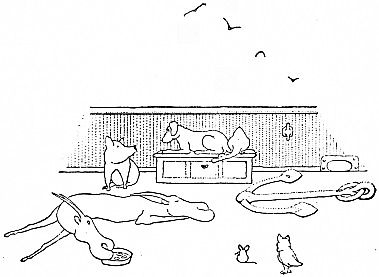 “‘You stupid piece of warm bacon!’”
“Couldn’t I?” said the dog. “That’s all youknow, you stupid piece of warm bacon! I[154]haven’t begun to try yet, have I? You wait andsee!”
Then Jip went to the Doctor and said,
“Ask the boy if he has anything in his pocketsthat belonged to his uncle, will you, please?”
So the Doctor asked him. And the boyshowed them a gold ring which he wore on apiece of string around his neck because it wastoo big for his finger. He said his uncle gaveit to him when they saw the pirates coming.
Jip smelt the ring and said,
“That’s no good. Ask him if he has anythingelse that belonged to his uncle.”
Then the boy took from his pocket a great,big red handkerchief and said, “This was myuncle’s too.”
As soon as the boy pulled it out, Jip shouted,
“Snuff, by Jingo!—Black Rappee snuff.Don’t you smell it? His uncle took snuff—Askhim, Doctor.”
The Doctor questioned the boy again;and he said, “Yes. My uncle took a lot ofsnuff.”
“Fine!” said Jip. “The man’s as good as[155]found. ’Twill be as easy as stealing milk froma kitten. Tell the boy I’ll find his uncle forhim in less than a week. Let us go upstairsand see which way the wind is blowing.”
“But it is dark now,” said the Doctor. “Youcan’t find him in the dark!”
“I don’t need any light to look for a man whosmells of Black Rappee snuff,” said Jip as heclimbed the stairs. “If the man had a hardsmell, like string, now—or hot water, it wouldbe different. But snuff!—Tut, tut!”
“Does hot water have a smell?” asked theDoctor.
“Certainly it has,” said Jip. “Hot watersmells quite different from cold water. It iswarm water—or ice—that has the really difficultsmell. Why, I once followed a man forten miles on a dark night by the smell of thehot water he had used to shave with—for thepoor fellow had no soap.... Now then, letus see which way the wind is blowing. Wind isvery important in long-distant smelling. Itmustn’t be too fierce a wind—and of course itmust blow the right way. A nice, steady, damp[156]breeze is the best of all.... Ha!—This windis from the North.”
Then Jip went up to the front of the shipand smelt the wind; and he started mutteringto himself,
“Tar; Spanish onions; kerosene oil; wet raincoats;crushed laurel-leaves; rubber burning;lace-curtains being washed—No, my mistake,lace-curtains hanging out to dry; and foxes—hundredsof ’em—cubs; and—”
“Can you really smell all those differentthings in this one wind?” asked the Doctor.
“Why, of course!” said Jip. “And those areonly a few of the easy smells—the strong ones.Any mongrel could smell those with a cold inthe head. Wait now, and I’ll tell you some ofthe harder scents that are coming on this wind—afew of the dainty ones.”
Then the dog shut his eyes tight, poked hisnose straight up in the air and sniffed hard withhis mouth half-open.
For a long time he said nothing. He kept asstill as a stone. He hardly seemed to be breathingat all. When at last he began to speak, it[157]sounded almost as though he were singing, sadly,in a dream.
“Bricks,” he whispered, very low—“old yellowbricks, crumbling with age in a garden-wall;the sweet breath of young cows standingin a mountain-stream; the lead roof of a dove-cote—orperhaps a granary—with the mid-daysun on it; black kid gloves lying in a bureau-drawerof walnut-wood; a dusty road with ahorses’ drinking-trough beneath the sycamores;little mushrooms bursting through the rottingleaves; and—and—and—”
“Any parsnips?” asked Gub-Gub.
“No,” said Jip. “You always think of thingsto eat. No parsnips whatever. And no snuff—plentyof pipes and cigarettes, and a few cigars.But no snuff. We must wait till the windchanges to the South.”
“Yes, it’s a poor wind, that,” said Gub-Gub.“I think you’re a fake, Jip. Who ever heard offinding a man in the middle of the ocean just bysmell! I told you you couldn’t do it.”
“Look here,” said Jip, getting really angry.“You’re going to get a bite on the nose in a minute![158]You needn’t think that just because theDoctor won’t let us give you what you deserve,that you can be as cheeky as you like!”
“Stop quarreling!” said the Doctor—“Stop it!Life’s too short. Tell me, Jip, where do youthink those smells are coming from?”
“From Devon and Wales—most of them,” saidJip—“The wind is coming that way.”
“Well, well!” said the Doctor. “You knowthat’s really quite remarkable—quite. I mustmake a note of that for my new book. I wonderif you could train me to smell as well asthat.... But no—perhaps I’m better off theway I am. ‘Enough is as good as a feast,’ theysay. Let’s go down to supper. I’m quite hungry.”
“So am I,” said Gub-Gub.
[159]
THE NINETEENTH CHAPTER
THE ROCK
UP they got, early next morning,out of the silken beds; and theysaw that the sun was shiningbrightly and that the wind wasblowing from the South.
Jip smelt the South wind forhalf an hour. Then he came to the Doctor,shaking his head.
“I smell no snuff as yet,” he said. “We mustwait till the wind changes to the East.”
But even when the East wind came, at threeo’clock that afternoon, the dog could not catchthe smell of snuff.
The little boy was terribly disappointed andbegan to cry again, saying that no one seemedto be able to find his uncle for him. But all Jipsaid to the Doctor was,
“Tell him that when the wind changes to[160]the West, I’ll find his uncle even though he bein China—so long as he is still taking BlackRappee snuff.”
Three days they had to wait before the Westwind came. This was on a Friday morning,early—just as it was getting light. A fine rainymist lay on the sea like a thin fog. And thewind was soft and warm and wet.
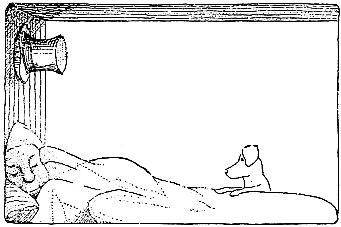 “‘Doctor!’ he cried. ‘I’ve got it!’”
As soon as Jip awoke he ran upstairs andpoked his nose in the air. Then he got mostfrightfully excited and rushed down again towake the Doctor up.
“Doctor!” he cried. “I’ve got it! Doctor![161]Doctor! Wake up! Listen! I’ve got it!The wind’s from the West and it smells of nothingbut snuff. Come upstairs and start the ship—quick!”
So the Doctor tumbled out of bed and wentto the rudder to steer the ship.
“Now I’ll go up to the front,” said Jip; “andyou watch my nose—whichever way I point it,you turn the ship the same way. The man cannotbe far off—with the smell as strong as this.And the wind’s all lovely and wet. Now watchme!”
So all that morning Jip stood in the frontpart of the ship, sniffing the wind and pointingthe way for the Doctor to steer; while all theanimals and the little boy stood round with theireyes wide open, watching the dog in wonder.
About lunch-time Jip asked Dab-Dab to tellthe Doctor that he was getting worried andwanted to speak to him. So Dab-Dab went andfetched the Doctor from the other end of theship and Jip said to him,
“The boy’s uncle is starving. We must makethe ship go as fast as we can.”
[162]
“How do you know he is starving?” asked theDoctor.
“Because there is no other smell in the Westwind but snuff,” said Jip. “If the man werecooking or eating food of any kind, I wouldbe bound to smell it too. But he hasn’t evenfresh water to drink. All he is taking is snuff—inlarge pinches. We are getting nearer tohim all the time, because the smell growsstronger every minute. But make the ship goas fast as you can, for I am certain that theman is starving.”
“All right,” said the Doctor; and he sent Dab-Dabto ask the swallows to pull the ship, thesame as they had done when the pirates werechasing them.
So the stout little birds came down andonce more harnessed themselves to the ship.
And now the boat went bounding through thewaves at a terrible speed. It went so fast thatthe fishes in the sea had to jump for their livesto get out of the way and not be run over.
And all the animals got tremendously excited;and they gave up looking at Jip and turned to[163]watch the sea in front, to spy out any land orislands where the starving man might be.
But hour after hour went by and still the shipwent rushing on, over the same flat, flat sea; andno land anywhere came in sight.
And now the animals gave up chattering andsat around silent, anxious and miserable. Thelittle boy again grew sad. And on Jip’s facethere was a worried look.
At last, late in the afternoon, just as the sunwas going down, the owl, Too-Too, whowas perched on the tip of the mast, suddenlystartled them all by crying out at the top of hisvoice,
“Jip! Jip! I see a great, great rock in frontof us—look—way out there where the sky andthe water meet. See the sun shine on it—likegold! Is the smell coming from there?”
And Jip called back,
“Yes. That’s it. That is where the man is.—Atlast, at last!”
And when they got nearer they could see thatthe rock was very large—as large as a big field.No trees grew on it, no grass—nothing. The[164]great rock was as smooth and as bare as the backof a tortoise.
Then the Doctor sailed the ship right roundthe rock. But nowhere on it could a man beseen. All the animals screwed up their eyesand looked as hard as they could; and JohnDolittle got a telescope from downstairs.
But not one living thing could they spy—noteven a gull, nor a star-fish, nor a shred ofsea-weed.
They all stood still and listened, strainingtheir ears for any sound. But the only noisethey heard was the gentle lapping of the littlewaves against the sides of their ship.
Then they all started calling, “Hulloa, there!—HULLOA!”till their voices were hoarse.But only the echo came back from the rock.
And the little boy burst into tears and said,
“I am afraid I shall never see my uncle anymore! What shall I tell them when I gethome!”
But Jip called to the Doctor,
“He must be there—he must—he must! Thesmell goes on no further. He must be there, I[165]tell you! Sail the ship close to the rock andlet me jump out on it.”
So the Doctor brought the ship as close ashe could and let down the anchor. Then heand Jip got out of the ship on to the rock.
Jip at once put his nose down close to theground and began to run all over the place. Upand down he went, back and forth—zig-zagging,twisting, doubling and turning. Andeverywhere he went, the Doctor ran behind him,close at his heels—till he was terribly out ofbreath.
At last Jip let out a great bark and sat down.And when the Doctor came running up to him,he found the dog staring into a big, deep hole inthe middle of the rock.
“The boy’s uncle is down there,” said Jipquietly. “No wonder those silly eagles couldn’tsee him!—It takes a dog to find a man.”
So the Doctor got down into the hole, whichseemed to be a kind of cave, or tunnel, runninga long way under the ground. Then he strucka match and started to make his way along thedark passage with Jip following behind.
[166]
The Doctor’s match soon went out; and hehad to strike another and another and another.
At last the passage came to an end; and theDoctor found himself in a kind of tiny roomwith walls of rock.
And there, in the middle of the room, his headresting on his arms, lay a man with very redhair—fast asleep!
Jip went up and sniffed at something lyingon the ground beside him. The Doctor stoopedand picked it up. It was an enormous snuff-box.And it was full of Black Rappee!
[167]
THE TWENTIETH CHAPTER
THE FISHERMAN’S TOWN
GENTLY then—very gently, theDoctor woke the man up.
But just at that moment thematch went out again. Andthe man thought it was Ben Alicoming back, and he began topunch the Doctor in the dark.
But when John Dolittle told him who it was,and that he had his little nephew safe on hisship, the man was tremendously glad, and saidhe was sorry he had fought the Doctor. He hadnot hurt him much though—because it was toodark to punch properly. Then he gave theDoctor a pinch of snuff.
And the man told how the Barbary Dragonhad put him on to this rock and left him there,when he wouldn’t promise to become a pirate;and how he used to sleep down in this hole because[168]there was no house on the rock to keephim warm.
And then he said,
“For four days I have had nothing to eat ordrink. I have lived on snuff.”
“There you are!” said Jip. “What did I tellyou?”
So they struck some more matches and madetheir way out through the passage into the daylight;and the Doctor hurried the man down tothe boat to get some soup.
When the animals and the little boy saw theDoctor and Jip coming back to the ship witha red-headed man, they began to cheer and yelland dance about the boat. And the swallowsup above started whistling at the top of theirvoices—thousands and millions of them—toshow that they too were glad that the boy’s braveuncle had been found. The noise they madewas so great that sailors far out at sea thoughtthat a terrible storm was coming. “Hark tothat gale howling in the East!” they said.
And Jip was awfully proud of himself—though[169]he tried hard not to look conceited.When Dab-Dab came to him and said, “Jip, Ihad no idea you were so clever!” he just tossedhis head and answered,
“Oh, that’s nothing special. But it takes adog to find a man, you know. Birds are no goodfor a game like that.”
Then the Doctor asked the red-haired fishermanwhere his home was. And when he hadtold him, the Doctor asked the swallows to guidethe ship there first.
And when they had come to the land whichthe man had spoken of, they saw a little fishing-townat the foot of a rocky mountain; and theman pointed out the house where he lived.
And while they were letting down the anchor,the little boy’s mother (who was also the man’ssister) came running down to the shore to meetthem, laughing and crying at the same time.She had been sitting on a hill for twenty days,watching the sea and waiting for them to return.
And she kissed the Doctor many times, so that[170]he giggled and blushed like a school-girl. Andshe tried to kiss Jip too; but he ran away andhid inside the ship.
“It’s a silly business, this kissing,” he said.“I don’t hold by it. Let her go and kiss Gub-Gub—ifshe mustkiss something.”
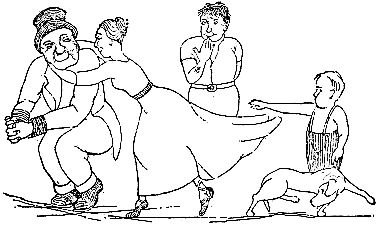 “And she kissed the Doctor many times”
The fisherman and his sister didn’t want theDoctor to go away again in a hurry. Theybegged him to spend a few days with them. SoJohn Dolittle and his animals had to stay attheir house a whole Saturday and Sunday andhalf of Monday.
And all the little boys of the fishing-villagewent down to the beach and pointed at the great[171]ship anchored there, and said to one another inwhispers,
“Look! That was a pirate-ship—Ben Ali’s—themost terrible pirate that ever sailed theSeven Seas! That old gentleman with the highhat, who’s staying up at Mrs. Trevelyan’s, hetook the ship away from The Barbary Dragon—andmade him into a farmer. Who’d havethought it of him—him so gentle-like and all!...Look at the great red sails! Ain’t she thewicked-looking ship—and fast?—My!”
All those two days and a half that the Doctorstayed at the little fishing-town the people keptasking him out to teas and luncheons and dinnersand parties; all the ladies sent him boxesof flowers and candies; and the village-bandplayed tunes under his window every night.
At last the Doctor said,
“Good people, I must go home now. Youhave really been most kind. I shall always rememberit. But I must go home—for I havethings to do.”
Then, just as the Doctor was about to leave,the Mayor of the town came down the street[172]and a lot of other people in grand clothes withhim. And the Mayor stopped before the housewhere the Doctor was living; and everybody inthe village gathered round to see what was goingto happen.
After six page-boys had blown on shiningtrumpets to make the people stop talking, theDoctor came out on to the steps and the Mayorspoke.
“Doctor John Dolittle,” said he: “It is agreat pleasure for me to present to the man whorid the seas of the Dragon of Barbary this littletoken from the grateful people of our worthyTown.”
And the Mayor took from his pocket a littletissue-paper packet, and opening it, he handedto the Doctor a perfectly beautiful watch withreal diamonds in the back.
Then the Mayor pulled out of his pocket astill larger parcel and said,
“Where is the dog?”
Then everybody started to hunt for Jip. Andat last Dab-Dab found him on the other sideof the village in a stable-yard, where all the[173]dogs of the country-side were standing roundhim speechless with admiration and respect.
When Jip was brought to the Doctor’s side,the Mayor opened the larger parcel; and insidewas a dog-collar made of solid gold! And agreat murmur of wonder went up from the village-folkas the Mayor bent down and fastenedit round the dog’s neck with his own hands.
For written on the collar in big letters werethese words: “JIP—The Cleverest Dog in theWorld.”
Then the whole crowd moved down to thebeach to see them off. And after the red-hairedfisherman and his sister and the little boy hadthanked the Doctor and his dog over and overand over again, the great, swift ship with thered sails was turned once more towards Puddlebyand they sailed out to sea, while the village-bandplayed music on the shore.
[174]
THE LAST CHAPTER
HOME AGAIN
MARCH winds had come andgone; April’s showers wereover; May’s buds had openedinto flower; and the June sunwas shining on the pleasantfields, when John Dolittle atlast got back to his own country.
But he did not yet go home to Puddleby.First he went traveling through the land withthe pushmi-pullyu in a gipsy-wagon, stopping atall the country-fairs. And there, with the acrobatson one side of them and the Punch-and-Judyshow on the other, they would hang out abig sign which read, “Come and See theMarvelous Two-Headed Animal from theJungles of Africa. Admission Sixpence.”
And the pushmi-pullyu would stay inside thewagon, while the other animals would lie about[175]underneath. The Doctor sat in a chair in fronttaking the sixpences and smiling on the peopleas they went in; and Dab-Dab was kept busyall the time scolding him because he would letthe children in for nothing when she wasn’tlooking.
And menagerie-keepers and circus-men cameand asked the Doctor to sell them the strangecreature, saying they would pay a tremendouslot of money for him. But the Doctor alwaysshook his head and said,
“No. The pushmi-pullyu shall never be shutup in a cage. He shall be free always to comeand go, like you and me.”
Many curious sights and happenings they sawin this wandering life; but they all seemed quiteordinary after the great things they had seenand done in foreign lands. It was very interestingat first, being sort of part of a circus;but after a few weeks they all got dreadfullytired of it and the Doctor and all of them werelonging to go home.
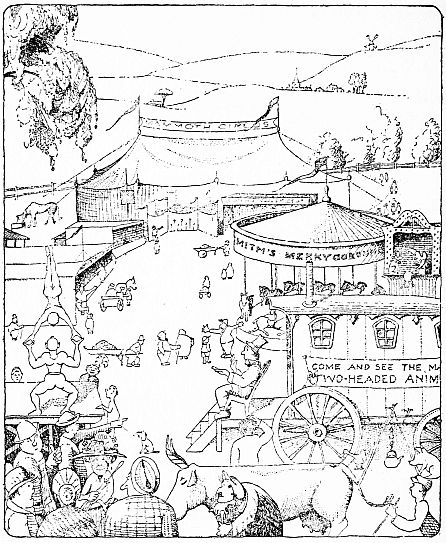 “The Doctor sat in a chair in front”
But so many people came flocking to the littlewagon and paid the sixpence to go inside and[176]
[177]see the pushmi-pullyu that very soon the Doctorwas able to give up being a showman.And one fine day, when the hollyhocks werein full bloom, he came back to Puddleby a richman, to live in the little house with the biggarden.
And the old lame horse in the stable was gladto see him; and so were the swallows who hadalready built their nests under the eaves of hisroof and had young ones. And Dab-Dab wasglad, too, to get back to the house she knew sowell—although there was a terrible lot of dustingto be done, with cobwebs everywhere.
And after Jip had gone and shown his goldencollar to the conceited collie next-door, he cameback and began running round the garden likea crazy thing, looking for the bones he hadburied long ago, and chasing the rats out of thetool-shed; while Gub-Gub dug up the horseradishwhich had grown three feet high in thecorner by the garden-wall.
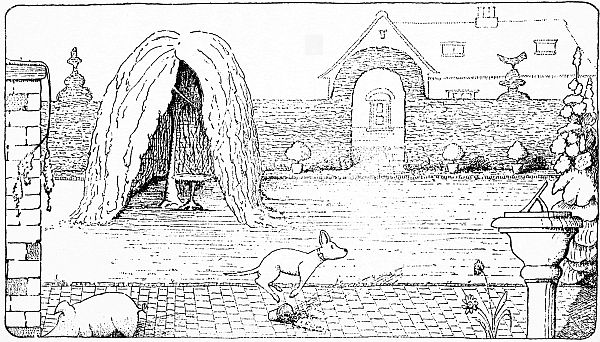 “He began running round the garden like a crazy thing”
And the Doctor went and saw the sailor whohad lent him the boat, and he bought two newships for him and a rubber-doll for his baby;[178]
[179]and he paid the grocer for the food he had lenthim for the journey to Africa. And he boughtanother piano and put the white mice back init—because they said the bureau-drawer wasdrafty.Even when the Doctor had filled the oldmoney-box on the dresser-shelf, he still had alot of money left; and he had to get three moremoney-boxes, just as big, to put the rest in.
“Money,” he said, “is a terrible nuisance.But it’s nice not to have to worry.”
“Yes,” said Dab-Dab, who was toasting muffinsfor his tea, “it is indeed!”
And when the Winter came again, and thesnow flew against the kitchen-window, the Doctorand his animals would sit round the big,warm fire after supper; and he would read aloudto them out of his books.
But far away in Africa, where the monkeyschattered in the palm-trees before they went tobed under the big yellow moon, they would sayto one another,
“I wonder what The Good Man’s doing now—over[180]there, in the Land of the White Men!Do you think he ever will come back?”
And Polynesia would squeak out from thevines,
“I think he will—I guess he will—I hope hewill!”
And then the crocodile would grunt up atthem from the black mud of the river,
“I’m SURE he will—Go to sleep!”
Transcriber’s Notes:Page 79, period added at end of sentence (had not seen before.)
Page 119, single closing quote added to caption about rats.
Up: 35379Down: 41
The Story of Doctor Dolittle
people engaged | Time: 2026-07-30 01:07:02
Related articles
- The Project Gutenberg eBook of ABC's of Science, by Charles A. Oliver
- Unconscious Comedians, by Honore de Balzac
- Country Sentiment, by Robert Graves
- Dream Life and Real Life, by Olive Schreiner
- Other Things Being Equal, by Emma Wolf
- Love for Love, by William Congreve
- The Project Gutenberg eBook of Salomé, by Oscar Wilde
- Somebody's Luggage
- The Recruit, by Honore de Balzac
- Juana, by Honore de Balzac


Comments